
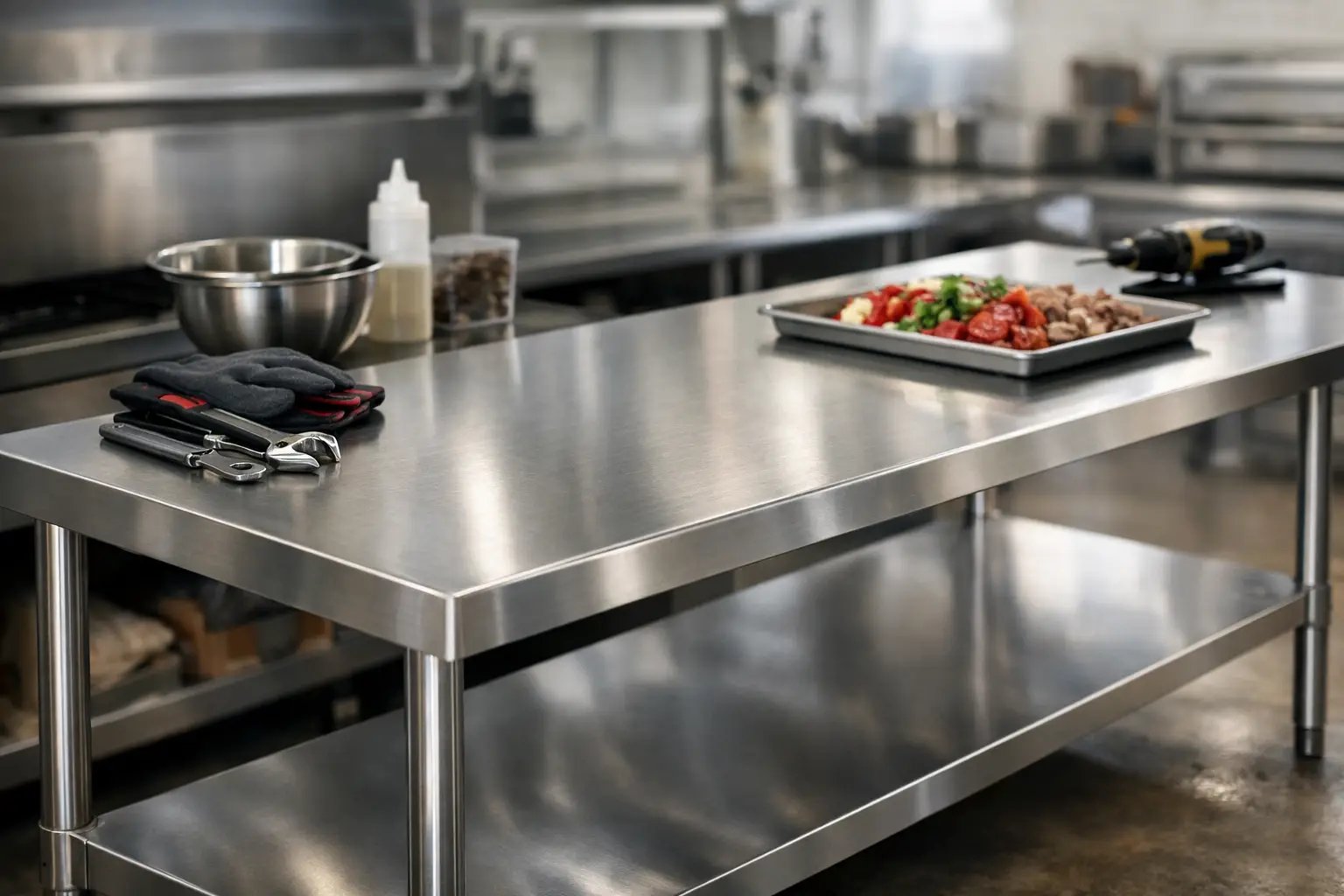
A prep bench is where the real pace of a commercial kitchen is set. If it wobbles, traps grime, runs out of room or sits at the wrong height, every service feels harder than it should. Stainless steel benches give restaurants, cafés, takeaway shops, caterers and institutional kitchens a hygienic, hard-wearing surface that can keep up with daily preparation, plating, packing and wash-up.
The right bench is not simply a flat piece of stainless steel. It needs to suit the way your team moves, the equipment around it and the cleaning standards your operation must maintain. Get those details right at the planning stage and a bench becomes one of the most useful pieces of equipment in the kitchen.
Why stainless steel benches suit commercial kitchens
Commercial kitchens ask a lot of their work surfaces. They handle raw ingredients, hot pans, heavy mixing bowls, cleaning chemicals, delivery boxes and constant wiping down. Stainless steel is popular because it is non-porous, straightforward to clean and resistant to the moisture and food spills that quickly damage timber, laminate or painted surfaces.
It also gives chefs and kitchen hands a neutral, food-safe work area that suits almost every task. A bench can become a vegetable prep station in the morning, a plating area during lunch trade and a packing station for takeaway orders at night. For busy operators, that flexibility matters.
There is a practical visual benefit too. A clean stainless surface makes dirt, residue and clutter easy to spot. That helps staff maintain better cleaning habits and gives your kitchen a professional finish when inspectors, suppliers or customers can see behind the pass.
Choose the right stainless steel grade
Not all stainless is the same, and the cheapest option is not always the best value over the life of the kitchen. For most food preparation and wet-area applications, 304 stainless steel is the preferred choice. It offers strong corrosion resistance and stands up well to regular cleaning, food acids and moisture.
Lower-grade stainless may suit dry storage, low-use areas or a tight budget, but it can show staining or surface corrosion sooner in demanding conditions. This is especially relevant near dishwashers, sinks, coastal venues and kitchens using strong cleaning products every day.
Ask what grade is used for both the top and the frame. A good-looking benchtop paired with lighter-duty legs or bracing can create problems when the bench is loaded with equipment or stock. For high-volume food production, durability is worth considering before the bench arrives on site.
Thickness and construction matter
Bench thickness affects how stable and solid the work surface feels. Thin stainless can flex under heavy mixers, slicers, dough tubs or stacks of plates. A stronger top with properly welded joins, bracing and secure legs is a better fit for continuous commercial use.
Look closely at the underside as well as the top. Cross-bracing, reinforced corners and adjustable feet all make a difference. Adjustable feet are particularly useful on older premises where floors are rarely perfectly level. A stable bench is safer for knife work, prevents equipment from shifting and keeps liquids from pooling in unexpected places.
Plan your bench around kitchen workflow
Before choosing a size, stand in the kitchen and follow the path of a typical order. Where do ingredients arrive? Where are they stored? Where does prep happen, and where do finished dishes leave the pass? Stainless steel benches should support that movement rather than force staff to cross paths or carry hot food through crowded spaces.
A café may need a compact bench beside underbench refrigeration for sandwich prep and coffee service. A takeaway shop might need a longer central bench for packing orders, portioning and holding containers. A bakery could require a heavy-duty worktop with generous depth for dough handling, trays and benchtop machinery.
For larger venues, separating tasks is usually more efficient than relying on one oversized bench. A dedicated raw-food prep bench, a clean assembly bench and a plating or pass bench reduce cross-contamination risks and give each team member clearer working space.
Allow room to work and room to clean
Bench depth is often overlooked. A shallow bench can be suitable for shelving, pass-through areas or narrow service spaces, but food preparation usually needs enough depth for boards, containers and safe hand movement. Measure the usable area, not just the space between walls.
Leave clearance around refrigeration doors, combi ovens, dishwashers and cooking equipment. Staff need room to open doors fully, carry trays and clean behind equipment. In a small kitchen, a bench that is 100 mm too long can become an everyday frustration.
Where a bench sits against a wall, a splashback helps protect the wall from food debris and water. It also removes an awkward gap where grease and crumbs can collect. For a free-standing island bench, access from both sides can make it a highly productive central prep station, provided there is enough aisle space around it.
Storage options that keep the bench useful
The best stainless steel benches do more than provide a top surface. An undershelf is a simple way to keep trays, pots, dry goods or small appliances within reach without crowding the worktop. It is particularly useful in compact kitchens where every square metre needs to earn its place.
Open undershelves are easy to access and clean, while enclosed cabinets can protect stock from dust and create a neater appearance in visible areas. Drawers suit utensils, packaging, labels and small tools that would otherwise end up scattered across the bench.
Consider what needs to live beneath the surface before ordering. If the area is used for food prep, storing cleaning chemicals underneath may not be appropriate for your procedures. If you plan to slide tubs or ingredient bins under the bench, check the clearance between the floor and undershelf, not just the overall height.
Standard sizes or a custom bench?
Standard benches are often the quickest and most cost-effective option for replacements, temporary production areas or straightforward fitouts. They work well when your available space suits common widths and depths, and when the bench has a simple role such as prep, packing or dry storage.
Custom fabrication is worth considering when walls are out of square, equipment needs to be integrated, or the kitchen has an unusual workflow. A custom bench can be made around sinks, cut-outs, shelves, drawers, splashbacks and specific appliance dimensions. It can also help make practical use of corners, narrow gaps and long wall runs that standard equipment cannot fill neatly.
The trade-off is that custom work requires accurate measurement and more planning. It is far cheaper to confirm dimensions, service locations and equipment clearances before fabrication than to modify a finished bench later. For a new venue or major refurbishment, bench planning should sit alongside the kitchen layout, not be left until the end.
Cleaning and care for a longer service life
Stainless steel is low maintenance, not no maintenance. Wipe benches regularly with warm water, mild detergent and a clean cloth, then dry the surface to reduce water marks. Clean in the direction of the grain where visible brushing is present, as this helps maintain the finish.
Avoid steel wool, harsh abrasives and cleaning products containing chlorides where possible. These can scratch the surface or contribute to staining. Do not leave wet cloths, salt, acidic food residue or chemical containers sitting on the bench overnight.
Make cleaning part of the close-down routine, including the shelf, legs, feet and wall junctions. A bench that is easy to clean only stays easy to clean when staff can reach the areas around it. This is another reason to allow sensible access in the original layout.
Get the bench right before you fit out
A stainless bench may be one of the lower-cost items in a commercial kitchen, but it has an outsized effect on daily operations. It supports prep quality, food safety, staff comfort and the overall flow between refrigeration, cooking, wash-up and service.
CKE Sydney can help operators match benches and stainless workstations to the rest of the kitchen, whether you are replacing a single worn work surface or planning a complete fitout. Measure carefully, think through the busiest service period and choose a bench that gives your team space to work properly from day one.