
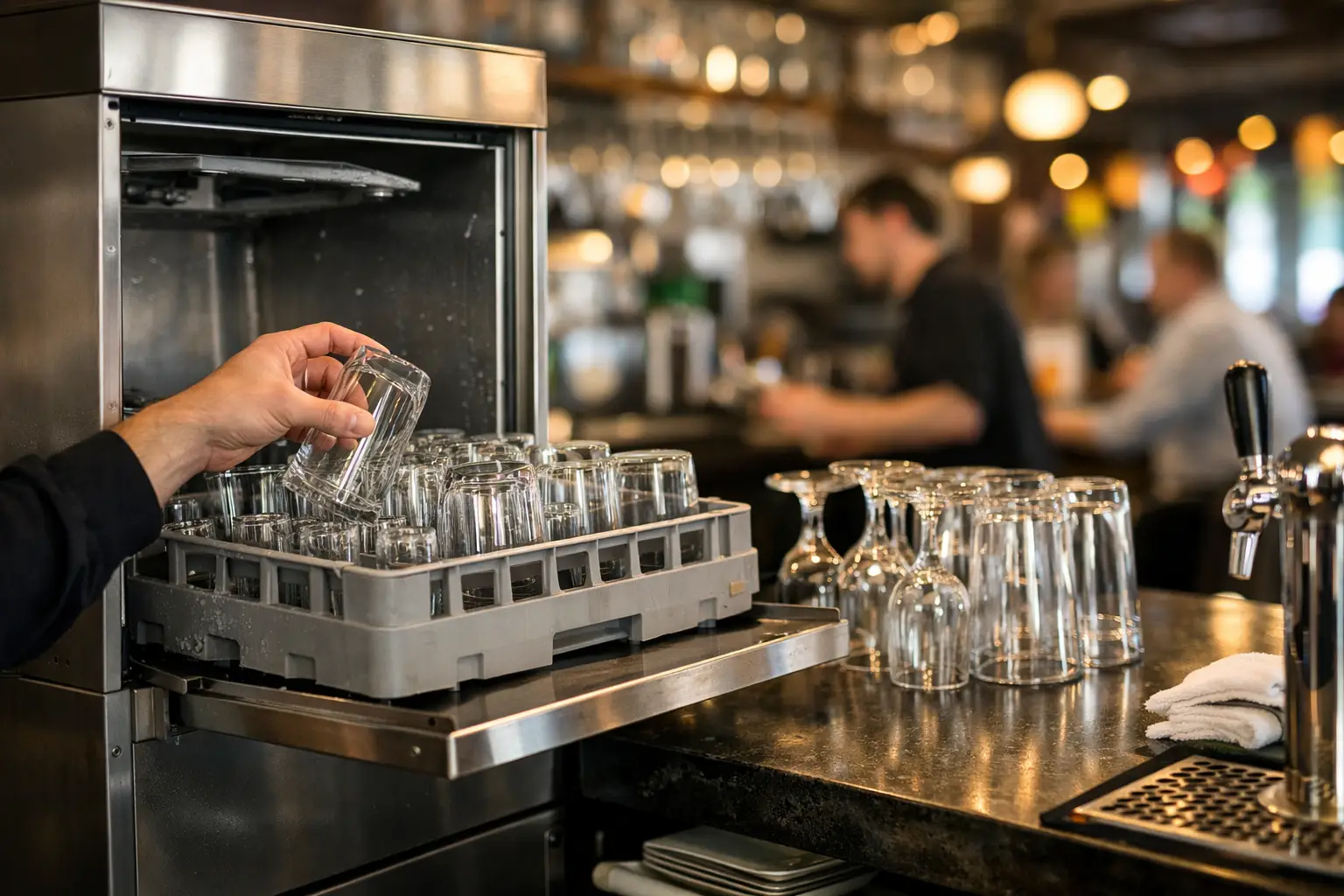
Friday evening service can expose a weak wash-up setup in minutes. Glasses stack up beside the bar, staff start reaching for warm or poorly polished stock, and a clean pour suddenly becomes harder to deliver. Choosing the right glasswasher for a busy pub is not simply about fitting a machine under the bench. It is about maintaining glass supply, presentation and service speed when the venue is under pressure.
For Australian pubs, clubs and bar operators, the best choice depends on the number of glasses used during peak trade, the type of drinks served, the available bench space and the quality of the local water supply. A machine that looks economical on the showroom floor can become expensive if it creates delays, requires excessive re-washing or leaves cloudy glassware behind.
Start with peak-hour demand, not daily covers
A pub may serve hundreds of drinks across a full day, but the real test is the busiest 60 to 90 minutes. Think about a Friday knock-off rush, a Saturday night with live music, or the interval before a major sporting event resumes. That is when glasses need to return from tables, be washed, dried and put back into service without staff searching for spares.
Start by estimating how many glasses return to the bar in a peak hour. Include schooners, pints, middies, wine glasses, cocktail glassware and any tasting paddles or small speciality items. Then consider how many racks a machine can process per hour under real operating conditions, not just the highest figure quoted for an ideal cycle.
A compact underbench glasswasher suits a small bar with steady trade and limited room. For a high-turnover pub, a larger underbench unit or pass-through machine may be the better commercial decision. A pass-through model can process higher volumes and allows a clearer dirty-to-clean workflow, but it needs more floor area and a bench layout that supports it.
Glasswasher for busy pub operations: cycle speed matters
Most commercial glasswashers offer short cycles, often around one to three minutes. A fast cycle is valuable, but it only helps if the machine recovers temperature quickly and staff can keep racks moving. A unit that slows down after several consecutive loads may not keep pace when the bar is three deep.
Look at the full working cycle. This includes loading, washing, unloading, placing glasses in a clean area and allowing enough time for them to air dry. Glasses should not be hand-dried with tea towels during service, as lint and handling can spoil the result. Good bar glassware should come out clean, clear and ready to use with minimal staff intervention.
For venues with a single bar, a practical approach is to hold enough glass stock for several machine loads. This gives the glasswasher breathing room during the busiest period. If your venue runs multiple bars, beer gardens or function spaces, each service point needs either its own wash-up capacity or a reliable system for returning glassware without creating bottlenecks.
Choose the right machine style for the space
Underbench glasswashers are a common choice for pubs because they fit beneath a counter and keep the wash-up point close to service. They are suitable where space is tight and the bar team needs fast access to clean glasses. The trade-off is capacity. One small machine may struggle in a venue with heavy draught beer sales, functions and late-night trade.
Pass-through glasswashers offer a higher-volume option. With an entry side for dirty racks and an exit side for clean racks, they support a more organised workflow. They are often a good fit for large pubs, clubs and venues where a dedicated glassy or bar-back manages glassware. However, they require sufficient clearance, suitable drainage and a sensible bench configuration.
A conveyor-style system can suit very large operations, but it is rarely necessary for a standard pub bar. It makes more sense where there is constant, significant volume across multiple service areas. Buying more capacity than you can use ties up capital and valuable back-of-house space, so match the machine to the actual operation rather than the occasional biggest night of the year.
Water quality affects every glass
Clear glassware is part of the customer experience. A clean pint glass that looks hazy, spotted or streaky can make even a well-poured beer appear less appealing. In many Sydney and Australian locations, water hardness and mineral content can affect wash results and contribute to scale inside the machine.
A suitable water softener or treatment system can reduce spotting, help protect heating elements and improve the consistency of the wash. It also supports the performance of detergent and rinse aid. This is not an optional extra to dismiss without checking your water conditions. For some venues, it is the difference between polishing glasses by hand and pulling consistently presentable glassware from the rack.
Use commercial-grade chemicals specified for the machine and keep chemical levels correctly set. Too little detergent leaves residue; too much can affect beer head retention and leave a film. A professional installation and correct commissioning are worthwhile because small setup errors can create ongoing service problems.
Plan the bench and utility requirements early
A glasswasher needs more than a spot on the floor. Before ordering, confirm the machine dimensions, door clearance, rack size, water inlet, waste connection, electrical requirements and ventilation around the unit. Measure the route into the venue as well. A machine that fits the bar opening still needs to get through the rear door, down the corridor and into position.
The wash-up area should move in one direction: dirty glasses arrive, are sorted into racks, washed, then unloaded onto a clean draining bench or storage shelf. Keeping dirty and clean zones separate makes service faster and supports good hygiene practice. Avoid placing clean glassware where it can be splashed by the pre-rinse area or handled unnecessarily.
Consider noise as well. An underbench glasswasher located directly behind the service bar can be convenient, but a loud machine may affect staff communication in a busy venue. Ask about operating noise if the bar is compact or customer-facing.
Factor in running costs and service access
Purchase price matters, particularly for a new venue or refurbishment, but it is only one part of the decision. Water consumption, power use, detergent, rinse aid, filters, replacement parts and downtime all affect the true cost of ownership.
A cheaper unit with limited local support may become a costly problem if it fails before a busy weekend. Choose equipment with accessible service support, available spare parts and a clear warranty. Ask what regular maintenance is required and whether filters, wash arms and tanks can be easily cleaned by staff at the end of a shift.
Daily care prevents many common problems. Bar staff should remove debris, rinse filters, check wash arms, wipe down seals and leave the machine clean according to the manufacturer instructions. Periodic descaling may also be needed, particularly where water is hard. These tasks take little time compared with the disruption of a machine that stops mid-service.
Buy for the service you want to run
The right glasswasher should make the bar feel calmer at the busiest point of trade. It should support quick turnarounds, clean presentation and a workflow that does not pull bartenders away from customers. If you are replacing an unreliable unit, changing a bar layout or fitting out a new pub, get the capacity and service requirements assessed before committing to a model.
CKE Sydney can help operators compare new and quality pre-owned commercial glasswashing equipment alongside benches, sinks and complete kitchen or bar fitout requirements. The practical next step is to map your peak-hour glass volume and available space, then select a machine that gives your team enough capacity before the next big service puts it to the test.