
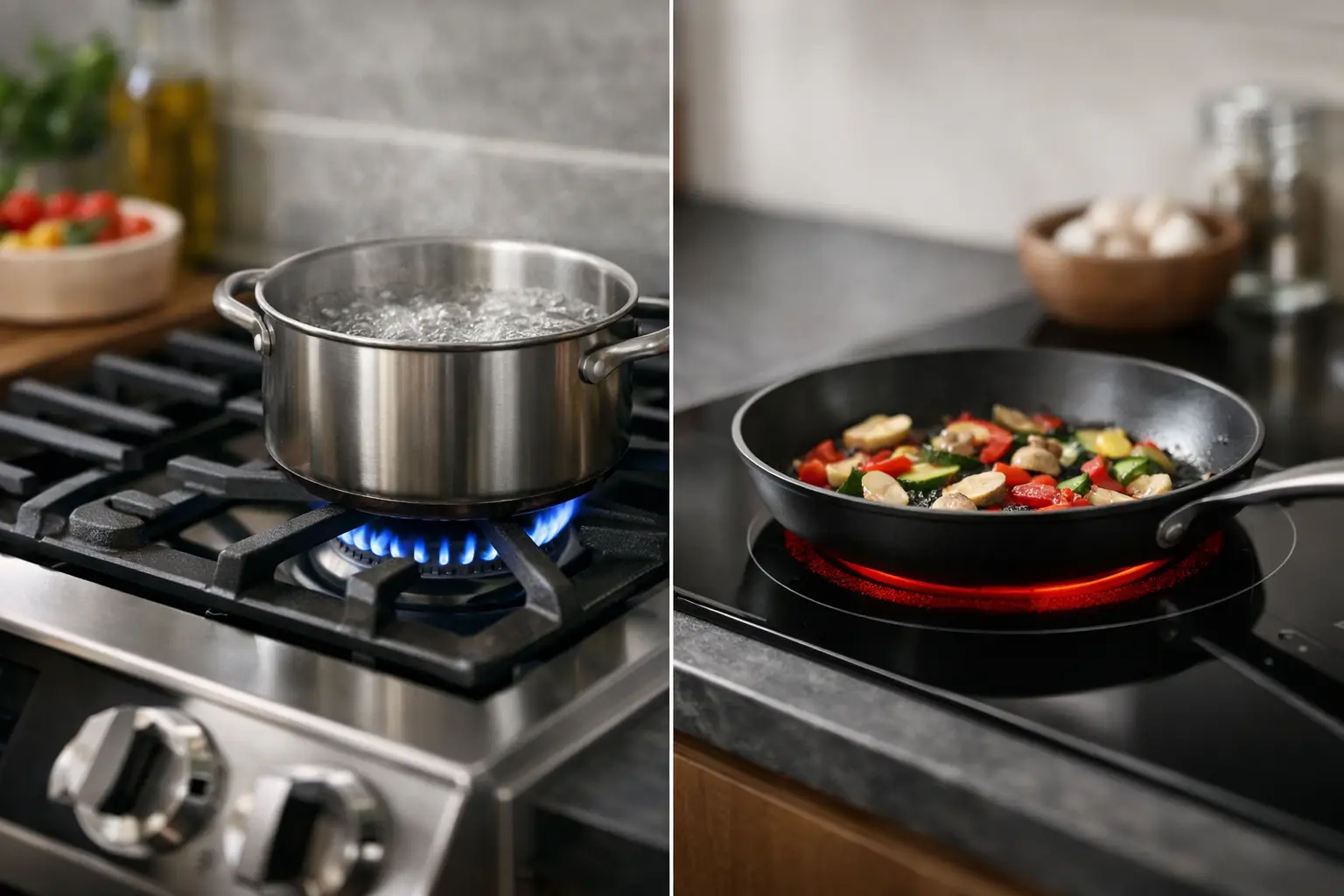
A busy service exposes weak cooking equipment quickly. If your pans crowd the pass, burners struggle to recover, or the kitchen feels unbearable by mid-service, the gas range versus induction cooktop decision is not a style preference. It affects ticket times, staff comfort, utility planning and the way your whole cookline is laid out.
For Australian restaurants, cafés, pubs, clubs, caterers and institutional kitchens, the right answer depends on what you cook, how hard you push equipment and what services are already available on site. A gas range remains a proven all-round workhorse. Induction offers fast, controlled heat with less waste heat, but it requires compatible cookware and the right electrical capacity.
Gas range versus induction cooktop: start with the job
The first point is easy to miss: a commercial gas range and an induction cooktop are not always like-for-like equipment. A gas range commonly combines open burners with a built-in gas oven. An induction cooktop is usually a cooktop only, so you may need to allow for a separate convection oven, combi oven or underbench oven.
That difference matters when planning a new venue or replacing an ageing appliance. If the goal is to replace one all-purpose unit that handles sauces, boiling, sautéing and roasting, a gas range can be the more direct replacement. If oven production is already covered elsewhere and the main issue is fast, precise pan cooking, induction may be the better fit.
Before comparing purchase prices, map your menu against each cooking position. A burger shop might need flat grilling and fryer capacity ahead of either option. A bistro with a sauce-heavy menu may value multiple open burners. A compact café kitchen producing breakfast, pasta and light lunch service may benefit from induction’s lower radiant heat.
Why commercial kitchens still choose gas ranges
Gas gives chefs an immediate visual cue. Turn the control and the flame changes straight away. For chefs used to working with open flame, this can feel intuitive during a fast service, particularly for wok cooking, charring, tossing pans and handling a broad mix of pan sizes.
A commercial range is also familiar, versatile and straightforward to specify. Four- or six-burner configurations, with or without an oven, suit many independent restaurants and pubs because they put several cooking functions into one footprint. Heavy-duty models can handle sustained use with stockpots, sauté pans and saucepans moving continuously across the line.
Gas equipment can remain workable through some electrical issues, although extraction, ignition systems and other kitchen equipment may still rely on power. That is not a reason to ignore electrical planning, but it can be relevant for venues concerned about service continuity.
The trade-off is heat. Open burners release a significant amount of heat into the kitchen rather than directly into the pan. In a hot Sydney summer, that puts more pressure on canopy extraction and air-conditioning, and it can make a tight cookline harder on staff. Gas also needs a compliant gas connection, suitable ventilation, regular cleaning and servicing of burners, pilots and related components.
Gas ranges are not automatically the low-cost option simply because gas has traditionally been cheaper. Actual operating cost depends on local tariffs, the efficiency of the appliance, kitchen hours and how much heat is lost into the room. Assess the total cost of operating the line, not just the monthly gas bill.
When gas makes practical sense
Gas is often the sensible choice for venues with existing gas infrastructure, a menu built around high-heat pan work, or a need for a combined burner-and-oven unit. It also suits operators who want a familiar platform for a varied menu without changing cookware or staff habits.
For specialised Asian cooking, standard open burners are only part of the picture. A purpose-built wok burner provides the concentrated output and wok support needed for serious volume. Choosing a gas range when the menu really calls for a wok station can create a bottleneck from day one.
Where induction earns its place
Induction heats the pan through a magnetic field rather than heating the cooking surface with a flame or exposed element. The cookware becomes the heat source, which means heat transfer is very efficient. Water boils quickly, pan temperature changes respond promptly and much less heat spills into the surrounding kitchen.
That reduced radiant heat is one of induction’s biggest commercial advantages. It can improve comfort on a compact line, reduce the load on cooling systems and make front-of-house cooking or event catering more practical. The glass surface is also flat, so spills are generally easier to wipe away once the surface has cooled.
Induction is particularly useful where consistency and control matter: sauces, delicate proteins, low-volume à la carte work, finishing stations, demonstration cooking and satellite kitchens. A chef can maintain a gentle simmer without the broad ambient heat produced by a bank of open gas burners.
However, induction is not a fit-and-forget purchase. It needs induction-compatible pots and pans with magnetic bases. Some existing aluminium, copper or non-magnetic stainless-steel cookware will not work. Heavy, warped or rough-bottomed cookware can also be a poor match for glass cooking surfaces.
Electrical supply is the other major consideration. Commercial induction equipment may require single-phase or three-phase power depending on the unit and output. Your electrician should confirm available supply, circuit capacity, isolators, cable runs and switchboard headroom before equipment is ordered. An attractive cooktop price can quickly change if electrical upgrades are needed.
Induction limits to plan around
Not every induction unit is designed for continuous high-output cooking. The quality of the unit, number of zones, wattage per zone and duty cycle all matter. A light-duty benchtop unit may be excellent for a café’s occasional sauce work but unsuitable as the main cookline for a 180-cover restaurant.
Induction tops also need careful daily treatment. Do not drag heavy pots across the glass, avoid slamming cookware down and keep vents clear. A cracked surface can take a cooking position out of action, so it pays to match the appliance grade to the pace of your operation rather than buying on price alone.
Compare the whole kitchen, not one appliance
A useful gas range versus induction cooktop comparison includes more than heat source. Consider ventilation, oven capacity, bench space, staff workflow, cookware, cleaning time and service access. The best appliance can still be the wrong purchase if it creates a pinch point at the pass or leaves no room for prep and plating.
Look at the equipment around it as well. A range may sit beside a chargrill, fryer and refrigerated prep bench under a canopy. An induction cooktop may work best as part of a modular line with a combi oven handling bulk roasting and baking. In a small kitchen, moving oven production to a combi can free up cookline space while adding programmed consistency.
For aged care, schools and institutional kitchens, induction may appeal because it reduces open-flame risk and excess room heat. Yet gas can remain the more practical option where kitchen teams need broad cookware flexibility and a simple, familiar replacement for existing ranges. There is no universal winner.
Buying questions to settle before you order
Ask how many pans must run at peak service, whether the menu relies on a built-in oven, and what your current gas and electrical services can support. Confirm the dimensions of the equipment, required clearances, bench height, canopy coverage and the access path through the building. A unit that cannot clear a doorway or fit beneath the canopy is an expensive problem.
Also check warranty terms, parts availability and the support available after installation. For pre-owned commercial equipment, inspect burner condition, oven doors, controls, seals and overall service history where available. A well-maintained pre-owned gas range can offer strong value, while a new induction unit may justify its cost through lower heat and efficient operation. The right choice depends on the specific unit, not only its fuel type.
If you are fitting out a new kitchen, involve your equipment supplier, kitchen designer, electrician, gas fitter and ventilation contractor early. CKE Sydney can help operators compare cooking equipment with the surrounding refrigeration, stainless benches, ovens and wash-up requirements, so the cookline works as a system rather than a collection of individual purchases.
Choose the appliance that keeps your busiest service moving with the least compromise. A practical site check, an honest look at the menu and properly confirmed services will do more for your kitchen than following a trend.