
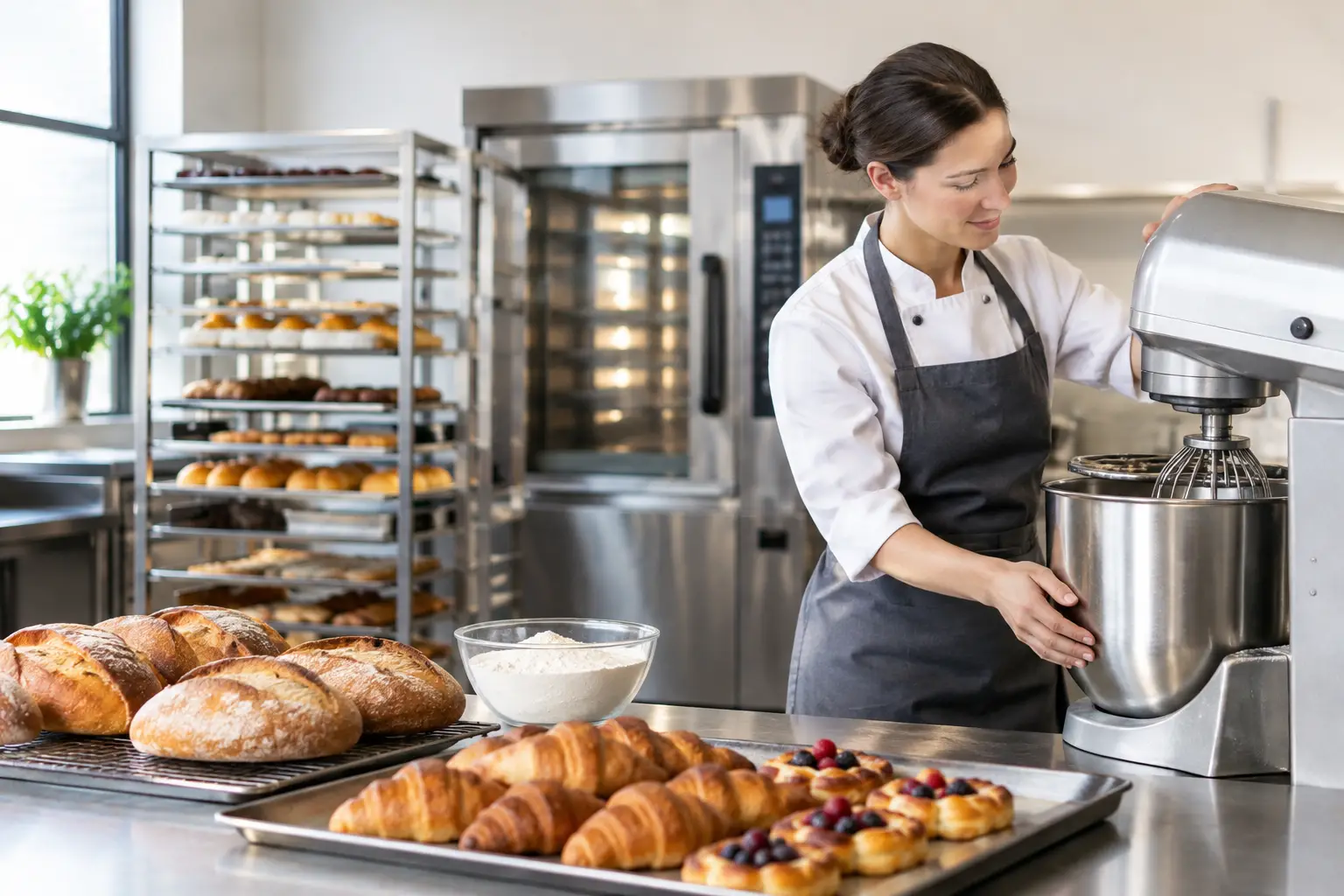
The 5 am bake-off does not leave much room for equipment that is slow, undersized or difficult to clean. The best bakery production equipment is not necessarily the biggest or most expensive option. It is the equipment that keeps dough moving, bakes consistently, protects product quality and suits the volume your team can realistically produce each day.
For a new bakery, café with a pastry program or established wholesale operation, buying in the right order matters. Start with the equipment that controls your production bottleneck, then build a layout that gives staff room to prepare, proof, bake, cool, store and pack without doubling back across the kitchen.
Start with your actual production plan
Before comparing brands, write down what you will make in a typical week. Bread, sourdough, croissants, pies, cakes, slices and biscuits all place different demands on a bakery fitout. A shop producing fresh rolls for a lunch rush needs quick recovery and reliable deck or convection baking. A pastry-led operation may place more value on controlled proofing, sheeting and refrigerated storage.
Daily volume matters, but peak volume matters more. If Friday and Saturday output is double the rest of the week, equipment needs to cope without forcing staff into excessive overtime or compromising consistency. Also consider batch size. A mixer that handles one large batch may look efficient, but it can be a poor fit if your recipes require several smaller doughs across the day.
Allow for growth, but avoid paying for capacity that will sit idle. There is a practical middle ground: select commercial equipment with enough headroom for busy periods, then make sure the power, gas, extraction and bench space can support an additional unit later if required.
Best bakery production equipment by workflow
A productive bakery follows a clear path from ingredient storage to finished product. Equipment should support that path rather than create congestion around a single bench or oven.
Mixers: the foundation of consistent dough
A commercial planetary mixer is highly versatile for cakes, buttercream, biscuit dough, batters and smaller dough batches. With the right attachments, it can mix, whip and blend, making it a strong choice for cafés and mixed-production bakeries. Check bowl capacity, motor power, speed settings and whether attachments are readily available.
For bread-heavy production, a spiral mixer is often the better investment. It develops yeast dough efficiently while keeping friction and dough temperature more controlled than many general-purpose mixers. This is particularly useful for high-hydration doughs and regular bread production. The trade-off is flexibility: a spiral mixer is designed for dough, not for whipping cream or making cake batter.
Do not choose mixer size on flour weight alone. Ask about minimum and maximum dough capacity, as some large mixers struggle with small batches. Also allow room to safely load ingredients, remove the bowl and clean around the machine.
Dough sheeters and dividers: speed without losing control
Laminated pastry is labour-intensive when it is rolled by hand all day. A dough sheeter provides even thickness for croissants, Danish pastries, puff pastry, pizza bases and fondant work. It can reduce physical strain on staff and improve portion consistency, which helps with bake results and food cost control.
A divider or divider-rounder may be worthwhile where rolls, buns and portioned dough are core lines. These machines can lift output significantly, but they need to suit your dough type and portion range. A small artisan bakery producing varied loaves may prefer manual scaling and shaping, while a high-volume roll program benefits from repeatable portions and faster handling.
Provers: consistency between the bench and the oven
Proofing is where many production schedules become difficult. Ambient conditions change through the year, and a warm Sydney summer can produce very different results from a cool winter morning. A commercial prover gives better control over temperature and humidity so dough can rise more predictably.
For operations producing frozen or retarded dough, a retarder-prover can add flexibility by slowing fermentation overnight and bringing product up to baking condition on schedule. It is a significant investment, so it makes most sense when early starts, labour availability or product consistency are regular challenges.
Ovens: buy for the products you sell most
The oven is usually the centre of bakery production, and there is no single right type. Deck ovens are valued for bread, pizza and artisan products where base heat, oven spring and crust matter. Models with steam injection are particularly useful for crusty loaves and baguettes.
Convection ovens suit trays of pastries, cakes, biscuits, pies and savoury products. Fan-forced airflow supports even baking across multiple trays, though delicate products may need careful settings. A rack oven can be a practical step up for wholesale bakeries and larger production runs, allowing an entire rack to be baked at once.
Combi ovens are not a replacement for every bakery oven, but they can be valuable in a café, hotel or multi-purpose commercial kitchen. Their programmable combination of heat, steam and fan control supports a broad menu beyond baking, from reheating and roasting to producing selected pastry and savoury lines.
When comparing ovens, look beyond tray count. Confirm tray dimensions, power or gas requirements, heat-up time, recovery between loads, ventilation needs and clearance for doors and racks. A well-priced oven that cannot fit through the access point or meet site services quickly becomes an expensive problem.
Refrigeration, blast chilling and storage
Butter-based pastry, fillings, cream products and prepared dough all depend on reliable cold storage. Underbench refrigeration keeps frequently used ingredients close to the production area, while upright fridges and freezers provide bulk capacity. Choose easy-clean interiors, sturdy shelving and enough door clearance for staff to work safely during a busy shift.
Blast chilling is useful for bakeries producing cream-filled items, cooked fillings, savoury pies or make-ahead components. It brings products through the danger zone quickly, helping with food safety and allowing a more organised production schedule. It may not be the first purchase for a small bread shop, but it can be a strong operational upgrade for caterers and bakeries with a broad prepared-food range.
Dry goods storage matters too. Flour bins, ingredient shelving and sealed containers keep stock accessible and help reduce waste. Position heavy flour and sugar close to the mixing area, but leave enough circulation space for trolleys and cleaning.
Do not overlook benches, racks and wash-up
Bakery equipment is often discussed in terms of mixers and ovens, yet stainless-steel benches, mobile racks, cooling racks, sinks and dishwashers determine how smoothly the team works between batches. A cramped packing bench or lack of cooling space can hold up production just as much as an undersized oven.
Stainless-steel workstations should be sized around the tasks performed on them. Allow dedicated areas for scaling ingredients, shaping dough, finishing pastries and packing orders. Mobile racks are particularly useful because they move trays from oven to cooling area to storage without constant handling. In a tight footprint, that can save minutes on every batch.
Plan wash-up capacity early. Mixing bowls, trays, utensils and baking tins build up quickly. A commercial dishwasher, suitable sink configuration and sensible drainage keep the production area cleaner and prevent the end-of-day wash from becoming a labour blowout.
Compare the full cost, not just the ticket price
Value is more than the purchase price. Check warranty coverage, availability of parts, cleaning requirements, energy use and the likely cost of installation. Gas equipment, larger ovens and refrigeration may need qualified trades, electrical upgrades, plumbing or ventilation work. These items should be part of the budget from the beginning.
Quality pre-owned bakery equipment can be a sensible option when budget is tight, particularly for benches, racks, display cabinets and selected machinery. Inspect its condition, service history, capacity and compatibility with your site before committing. New equipment may be the better choice where warranty protection, energy efficiency or exact output is critical.
For a complete fitout or a staged upgrade, CKE Sydney can help operators match bakery machinery, refrigeration, stainless steel and display equipment to the way their kitchen actually runs. Finance options can also make it easier to secure essential production equipment without placing all the pressure on opening-day cash flow.
Build a bakery that can keep moving
The right equipment should make the next task easier. Dough should move from mixer to bench, prover and oven with minimal lifting. Trays should have a clear route to cooling, finishing, display or packing. Staff should not be walking around hot equipment to reach refrigeration or stacking racks in front of an exit.
Measure the site carefully, check service requirements before ordering and think through a full production day rather than one ideal batch. A practical equipment plan gives your team the room to work well when orders increase, the cabinet needs refilling and the morning bake has to be ready on time.