
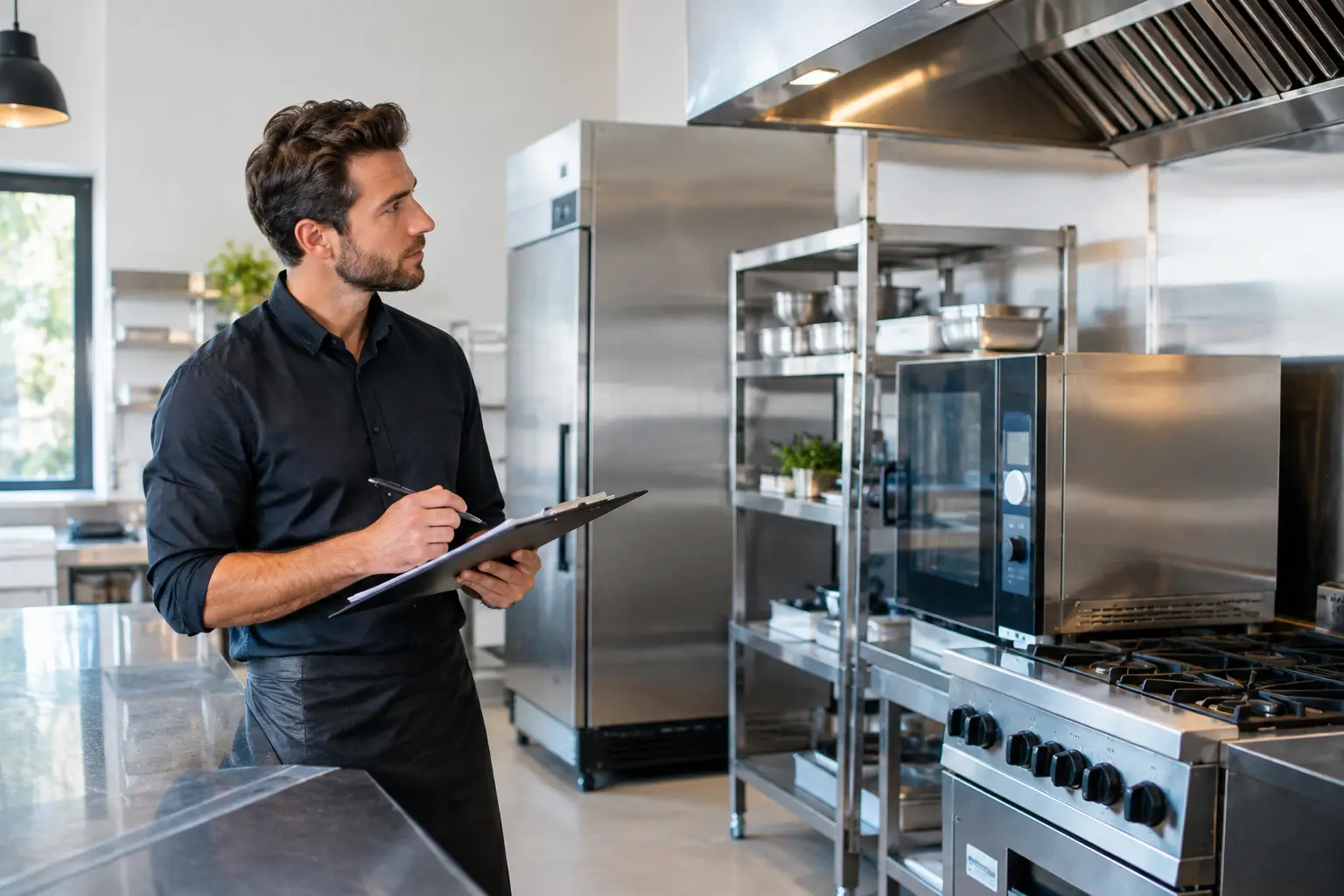
A kitchen can look fully fitted out and still fail its first busy Friday service. The usual problem is not one missing big-ticket item. It is the overlooked underbench fridge, the lack of landing space beside the fryer, the dishwasher that cannot keep up, or the power and gas services that were never allowed for. This restaurant equipment checklist helps Australian operators plan a kitchen around the way food actually moves from delivery to plate.
Start with your menu, expected covers, service style and available floor space. A 40-seat neighbourhood restaurant with a short menu needs a different equipment mix to a high-volume takeaway shop, pub bistro or aged-care kitchen. Buy capacity for your busiest realistic trading period, not for a quiet Tuesday lunch.
Start With Workflow, Not Product Categories
Before pricing ovens or refrigeration, map the journey of each key menu item. Deliveries need a receiving point, dry goods and chilled stock need storage, ingredients need preparation space, food needs cooking and holding capacity, then plates and utensils need an efficient wash-up path. Staff should not cross back through a hot line carrying dirty dishes or squeeze past a fryer with raw chicken trays.
A workable layout generally separates clean and dirty work, raw and ready-to-eat preparation, and hot and cold production. Leave enough room for doors to open, trays to be loaded and staff to move safely. Bench space is not spare space: it is where your team portions, plates, checks tickets and puts hot equipment down.
Also confirm site constraints early. Measure every doorway, passage, lift and turn between the delivery point and kitchen. Check ceiling height, floor drainage, ventilation, gas availability, electrical phases and water connections. A machine that fits the kitchen drawing may not fit through the front door, and changing services after installation is rarely cheap.
Restaurant Equipment Checklist: Core Kitchen Zones
The following categories cover the core equipment most restaurants need. Your final list should be shaped by menu and volume, but missing any of these zones can create an operational bottleneck.
Cooking line
Select the cooking equipment that matches how your menu is produced. Gas cooking ranges are flexible for sautéing, sauces and general service, while induction can suit venues needing responsive heat with less ambient heat in the kitchen. Combi ovens earn their space where you roast, steam, regenerate, bake or cook batch production. They can reduce the number of individual appliances required, but staff need to use programmed functions correctly and maintain them properly.
For a typical hot line, consider:
- Gas or electric ranges, cooktops and oven bases
- Combi ovens, convection ovens or deck ovens
- Chargrills, salamanders and griddles
- Deep fryers with adequate filtration and safe oil handling
- Wok burners for Asian menus and high-heat production
- Bain-maries, hot cupboards or heat lamps for pass holding
Do not choose a fryer or grill only by its footprint. Recovery time, basket capacity, ventilation requirements and cleaning access matter during a full service. A smaller piece of equipment may cost less upfront but slow the whole line when demand peaks.
Refrigeration and freezer storage
Refrigeration is where many new venues underbuy. You need capacity for deliveries, mise en place, service stock, beverages and separated raw ingredients. A single upright fridge may be adequate for a small café but will struggle in a restaurant receiving several days of stock at once.
Plan a combination of upright fridges or freezers for bulk storage, underbench refrigeration for line access, refrigerated prep benches for salads or pizza, and cool room or freezer room capacity where volume justifies it. Glass-door display fridges can support front-of-house sales, but they are not a substitute for organised back-of-house storage.
Allow clearance around refrigeration for airflow and servicing. Position units away from direct heat where possible. More importantly, build food safety into the layout: raw proteins, ready-to-eat foods and allergen-sensitive ingredients need clear, manageable separation.
Preparation and stainless-steel infrastructure
Stainless-steel benches, shelves, sinks and cabinetry rarely get the excitement of an oven, yet they determine whether the kitchen stays organised. Every production task needs a stable, cleanable surface at the right height. In a compact kitchen, custom stainless benches can make better use of awkward walls, corners and equipment gaps than standard pieces alone.
Include enough handwash basins for staff access, food preparation sinks where required, pot sinks, dishwashing benches, wall shelves and mobile benches or trolleys. Consider equipment such as mixers, food processors, slicers, mincers, vacuum sealers and rice cookers only where the menu and labour plan support them. Buying machinery that replaces repetitive manual work can be a strong investment. Buying machinery for a menu item you sell twice a week is not.
Wash-up and waste handling
Wash-up must be designed around the volume of plates, glassware, cutlery, pots and trays generated at peak service. An underbench dishwasher may suit a small café or bar, while a pass-through dishwasher is often a better fit for busy restaurants and clubs. Larger operations may require rack conveyors or dedicated glasswashers.
Allow dirty-dish landing space before the machine and clean-drain space after it. Confirm water pressure, drainage, detergent dosing and ventilation requirements before purchasing. Add waste bins, grease management provisions, shelving for clean crockery and a practical path for rubbish removal. If clean plates have nowhere to dry or be stored, wash-up will quickly spill into food preparation areas.
Do Not Forget Front-of-House and Support Equipment
The kitchen may drive production, but the customer experience and daily administration rely on other equipment too. Display cabinets are useful for cakes, chilled grab-and-go food, deli items and heated takeaway lines. Choose a cabinet based on product temperature, humidity needs, loading access and visual presentation, not just appearance.
Depending on the venue, your broader checklist may include ice machines, glasswashers, beverage refrigeration, coffee equipment, plate warmers, shelving, cash handling stations and mobile catering equipment. For bakeries, add planetary mixers, dough equipment, proving cabinets, bakery ovens and cooling racks according to production volume.
Small items deserve a separate budget. GN pans, trays, storage containers, thermometers, colour-coded boards, knives, utensils and cleaning equipment may seem minor individually, but the cost adds up quickly. They are also what let staff use the major equipment properly from day one.
Check Compliance, Services and Installation Before You Order
Commercial kitchen equipment must work with the site and relevant Australian requirements. Speak with qualified trades and your local approval authority about ventilation, fire suppression, grease arrestors, drainage, gas connections, electrical loads, accessibility and food premises requirements. Requirements can vary by council, building type and the nature of the operation.
Ask suppliers for equipment dimensions, service requirements, power ratings and product documentation before finalising your plan. For gas appliances, confirm the type of gas available and installation arrangements. For electrical equipment, check whether single-phase or three-phase power is needed. A combi oven, dishwasher or large refrigeration system can affect the overall electrical plan more than expected.
It is also sensible to plan for cleaning and maintenance. Can staff reach filters, condenser areas, drains and service panels? Is there room to pull a unit forward if it needs repair? Equipment that is hard to clean becomes less efficient, less reliable and harder to keep compliant.
New, Pre-Owned or a Mix?
New equipment gives you current features, manufacturer warranty coverage and a known service history. It is often the right choice for high-use essentials such as refrigeration, dishwashers and key cooking equipment. Quality pre-owned equipment can make sense when the budget is tight, particularly for stainless-steel benches, shelving, selected cooking appliances or equipment for a secondary prep area.
The best answer is often a mix. Put your budget into the equipment that will run all day and directly affect food safety or service speed. Save where condition, warranty and servicing support make the risk reasonable. Factor in delivery, installation, commissioning and any required fitout work rather than comparing purchase prices alone.
For a new venue, refurbishment or replacement project, CKE Sydney can help operators match equipment to workflow, site conditions and budget, from individual appliances through to a complete commercial kitchen fitout. Bring a menu, floor plan and realistic cover numbers to the conversation. The better the starting information, the more practical the final equipment plan will be.
A good kitchen is not the one with the most equipment. It is the one where every item earns its space, staff can work safely at pace, and the next service feels manageable rather than improvised.