
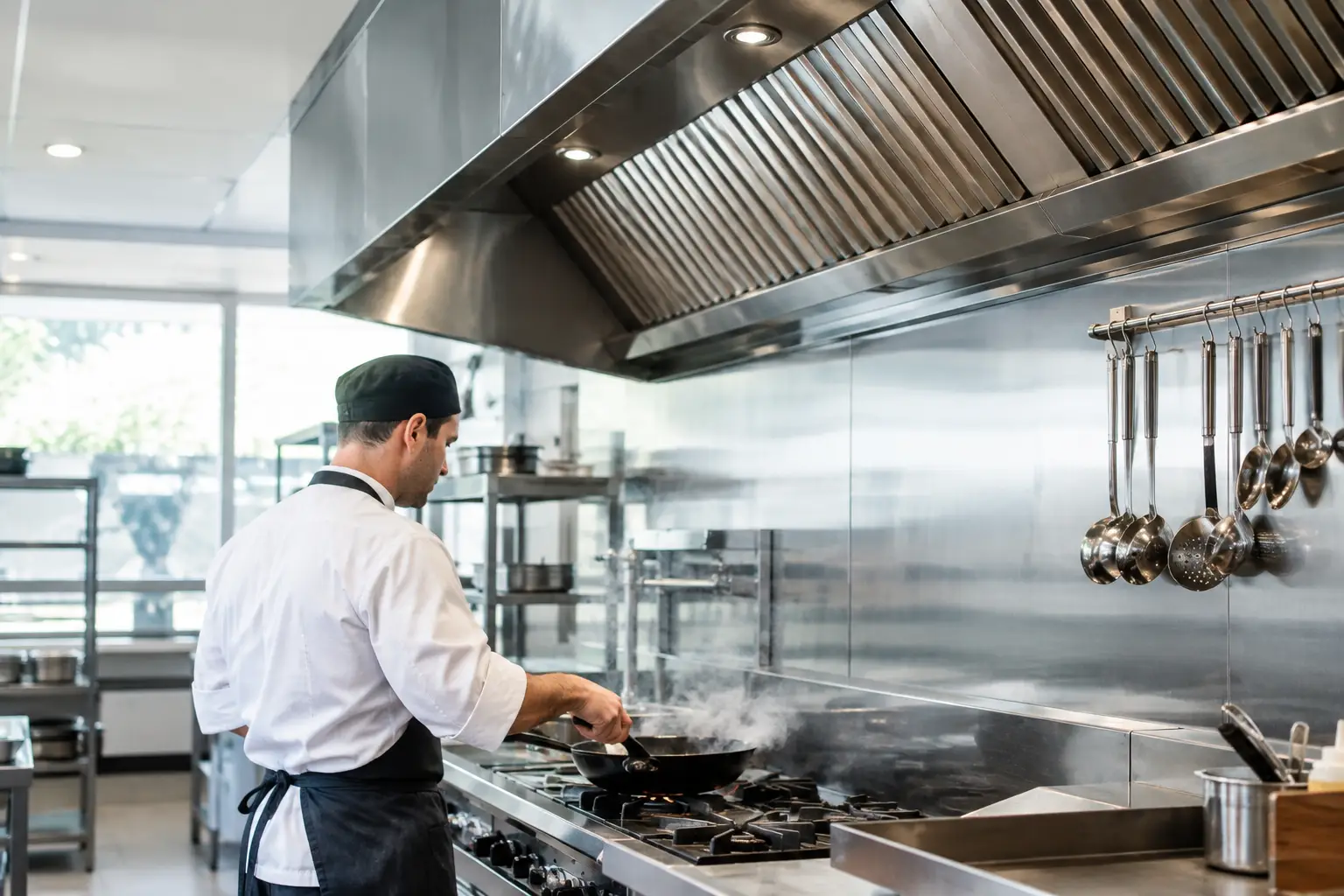
A busy grill line can turn a well-designed kitchen into a hot, smoky and uncomfortable workspace within minutes if the extraction is undersized or poorly positioned. This commercial kitchen ventilation guide is for operators planning a new fitout, replacing cooking equipment or trying to solve persistent heat, grease and odour issues without wasting money on the wrong system.
Ventilation is not an add-on to the kitchen plan. It affects where your cooking line sits, how much gas or electric equipment you can run, staff comfort, fire safety, energy use and whether the venue can meet approval requirements. Get it right early and the kitchen is easier to operate, clean and maintain. Get it wrong and even premium cooking equipment will struggle to perform as it should.
Why commercial kitchen ventilation needs proper planning
A commercial canopy must capture heat, steam, smoke, grease-laden vapours and combustion products at the source. It then needs to move that air through ductwork, filters and an exhaust fan to a suitable discharge point. The challenge is that every kitchen produces a different load.
A small café using a compact convection oven, panini press and dishwasher has very different ventilation needs from a takeaway shop running twin basket fryers, a chargrill and a wok burner through lunch and dinner. High-heat equipment creates a stronger thermal plume, while frying and solid-fuel cooking produce heavier grease and smoke loads. A canopy sized only by the width of the appliance often falls short.
Poor extraction has a direct operational cost. Staff work in excessive heat, grease settles on ceilings and equipment, odours travel into dining areas or neighbouring tenancies, and refrigeration has to work harder in a hotter room. In severe cases, smoke and heat can interrupt service or trigger complaints.
Start with the menu and cooking equipment
The best ventilation design starts with what you will actually cook, not with a standard canopy package. List every appliance that produces heat, steam, grease or combustion gases, then consider how it will be used during your busiest service period.
For example, a combi oven may produce substantial steam when its door opens, while a gas range, salamander and chargrill create high heat across a long cooking line. Wok burners need strong capture because of their intense heat output and cooking style. Fryers require effective grease extraction, particularly where several units run continuously.
Consider the following before choosing a bonnet or fan:
- The appliance type, fuel source and heat output
- The length and depth of the cooking line
- Whether equipment will run at the same time during peak trade
- The ceiling height, kitchen shape and location of walls or bulkheads
- The route available for ductwork and the exhaust discharge point
- Future equipment additions, menu expansion or increased production
Allowing room for future growth can be good value, but oversizing a system is not automatically better. Excessive airflow can increase noise, energy use and conditioned-air loss. The right outcome is a system matched to the cooking load, capture area and building constraints.
Canopy bonnets and condensate bonnets are not interchangeable
Canopy bonnets used over grease-producing cooking equipment need to capture airborne grease before it enters the duct. They commonly use baffle filters that can be removed and cleaned. This type of system is typically required over equipment such as ranges, grills, fryers, chargrills and wok stations, subject to the project requirements and approvals.
Steam-producing equipment may use a condensate bonnet or dedicated extraction arrangement where grease is not the primary concern. Dishwashers, combi ovens and boiling equipment can introduce large amounts of moisture into the kitchen. The right solution needs to manage steam without causing dripping, corrosion or excessive condensation in the ductwork.
Do not assume one bonnet can cover every item on a mixed cooking line. The equipment beneath it, the position of the filters and the fan capacity all need to work together. A kitchen designer can help establish a practical layout before equipment is ordered.
Commercial kitchen ventilation guide: balance the air
Extraction removes air from the kitchen. If that air is not replaced in a controlled way, the room can become negatively pressurised. Doors become difficult to open, smoke may spill from the canopy edge, draughts can affect gas burners and air may be pulled in from unsuitable areas such as bins, bathrooms or neighbouring tenancies.
Make-up air provides replacement air to balance the system. It may be introduced through ceiling diffusers, a dedicated supply system or another engineered arrangement. Placement matters. Air supplied too forcefully near the canopy can push smoke and vapours out into the kitchen rather than allowing the bonnet to capture them.
Air balance is especially important in enclosed shopping-centre sites, older buildings and kitchens with large exhaust demands. It also matters where air conditioning is expected to keep staff comfortable. Extracting expensive cooled air all day without a planned replacement-air strategy can make energy bills climb quickly.
Design the cooking line for capture and access
Ventilation performance is affected by the location of equipment. Canopies generally capture more effectively when appliances sit fully beneath the bonnet and are positioned away from strong cross-draughts. Open doors, pass-through windows and air-conditioning outlets can all interfere with the upward movement of heat and smoke.
Keep the hottest, greasiest equipment grouped where practical. A scattered layout may look convenient on a floor plan but can require several separate extraction points and more complicated ducting. Grouping a range, grill and fryer line under one correctly designed bonnet can reduce installation complexity and make cleaning more manageable.
Leave realistic space for staff to work, clean and service equipment. Filters must be removed safely, fryers need access for oil handling, and ductwork inspection points need to be reachable. Stainless-steel benches, splashbacks and shelving should support workflow without blocking the canopy capture zone.
If you are fitting out a compact tenancy, bench-top equipment can help preserve floor space, but it still needs to be assessed for ventilation. A bench-top chargrill or fryer is not low-risk simply because it has a small footprint.
Approvals, fire safety and discharge points
Commercial kitchen ventilation must be considered alongside building, fire and health requirements. Requirements can vary by council area, building class, tenancy conditions, equipment type and whether the site is new, refurbished or operating within an existing approved kitchen.
The exhaust discharge location deserves early attention. A duct route that looks simple inside the kitchen may become difficult once it reaches a roof, shared wall, common area or neighbouring property. Odour, noise, grease deposition and safe clearances can all affect the final design. Retrofitting a route after walls and ceilings are complete is usually far more expensive.
Grease extraction systems also need a suitable fire protection approach for the risk involved. This may include fire-rated ducting, suppression equipment, interlocks and emergency shut-off arrangements, depending on the design and applicable requirements. Work with qualified designers, installers and certifiers rather than relying on a generic online specification.
Before committing to equipment, confirm the project pathway with the relevant council, building surveyor, landlord and fire consultant where required. This is particularly important for gas appliances, solid-fuel cooking, shopping-centre tenancies and older buildings with limited service space.
Cleaning and maintenance protect the investment
A new extraction system will not stay effective without routine cleaning. Baffle filters collect grease quickly in high-volume kitchens and should be cleaned on a schedule that matches use. The canopy interior, ductwork and exhaust fan also require professional inspection and cleaning at intervals suited to the cooking load.
Warning signs include grease dripping from filters, visible smoke escaping the canopy, stronger cooking odours, noisy fans, reduced airflow and heat building up during service. Waiting until the system fails can mean lost trading time, emergency call-outs and a larger cleaning job.
Keep maintenance records, particularly where your insurer, landlord or local authority may request them. Regular checks also protect cooking equipment by reducing heat stress in the kitchen and helping staff spot faults before they become major repairs.
Build ventilation into the fitout budget
When comparing equipment prices, include the full ventilation scope: canopy, filters, ductwork, exhaust fan, make-up air, electrical work, controls, roof penetration, fire protection and installation access. A lower upfront quote can become costly if key items have been excluded.
For new venues and refurbishment projects, planning the cooking line, stainless workstations, refrigeration and ventilation as one package avoids avoidable clashes later. CKE Sydney can assist with practical equipment selection and commercial kitchen design so the appliances suit the available space and intended workflow.
Before you place an order, take your menu, equipment list and tenancy plans to a qualified kitchen design and ventilation professional. A clear plan at that stage gives you a better chance of opening with a kitchen that is safer, cooler and ready for a busy service.