
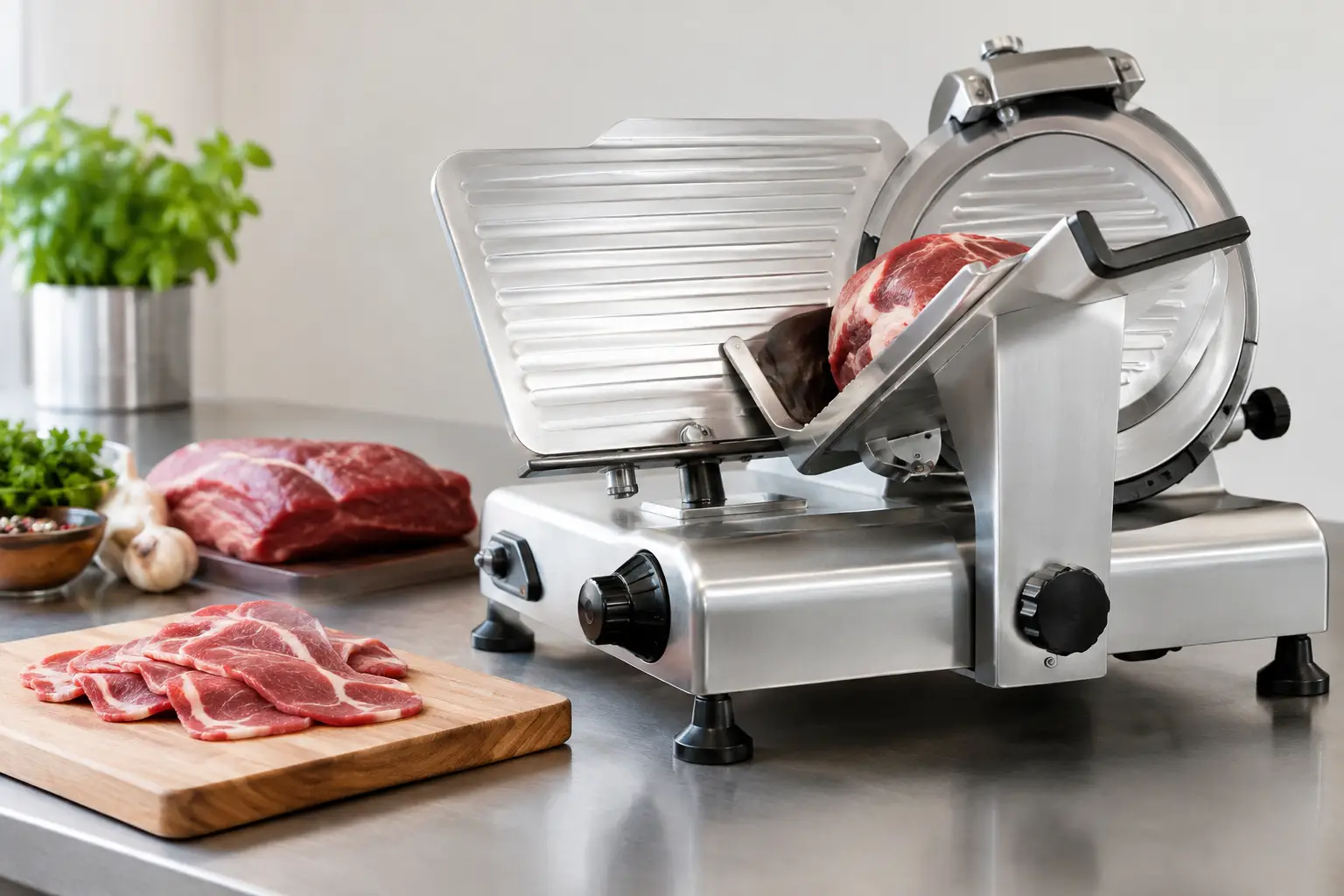
A commercial meat slicer can quickly become one of the busiest pieces of prep equipment in a deli, sandwich bar, café, butcher shop, club or high-volume kitchen. It gives you consistent portions, cleaner presentation and better control over food cost – but only if the machine suits the products and pace of your operation.
Buying on blade size or price alone can create problems later. A slicer that is too light-duty may struggle through a lunch rush, while an oversized unit can take up valuable bench space and cost more than your menu justifies. The right choice comes down to what you slice, how often you slice it and how confidently your team can clean and use the machine every day.
What a commercial meat slicer needs to handle
Start with the food you will put through it. Cooked ham, roast beef, salami, mortadella and cheese are common slicer products, but they do not all behave the same way. Soft products need a sharp, well-adjusted blade to avoid tearing. Firm cured meats and chilled roasts place greater demand on the motor and carriage. Frozen product should only be sliced if the manufacturer specifically approves it.
For a small café making toasties and a few deli-style sandwiches each day, a compact gravity-feed slicer may be more than enough. A busy takeaway shop, hotel breakfast kitchen or club bistro that portions meat through several service periods needs a more substantial machine with a stronger motor, smooth carriage travel and parts built for repeated use.
It also pays to think beyond meat. If the slicer will be used for cheese, vegetables or other ready-to-eat foods, your cleaning routine and allergen controls need to be clear. In some operations, separate equipment is the practical answer. In others, disciplined cleaning between products will be essential.
Blade size affects more than slice width
Blade diameter influences the size of product the slicer can accommodate, the speed of prep and the machine footprint. Smaller commercial units commonly use a 250 mm blade and are suited to modest-volume work. A 300 mm blade is often a practical middle ground for cafés, delis and restaurant kitchens. Larger 350 mm models are generally better suited to high-output foodservice, butcheries and venues slicing larger roasts or bulk product.
A larger blade is not automatically the better purchase. It can require more bench depth, additional clearance around the machine and a bigger upfront investment. If your team only slices a few kilograms of ham daily, a large-floor model may offer little return. On the other hand, choosing a small domestic-style unit for a commercial lunch trade is likely to mean slower prep, inconsistent slices and earlier replacement costs.
Look at carriage capacity as well as blade diameter. The product tray should securely hold the largest items on your menu without staff forcing or trimming them down unnecessarily. A good carriage grip, easy thickness adjustment and stable base all make a real difference when the slicer is in constant use.
Gravity-feed or vertical slicer?
Gravity-feed slicers use an angled carriage that lets the product move towards the blade with less effort. They are a popular choice for cooked meats, deli products and general kitchen prep because they are straightforward to operate and efficient for most everyday applications.
Vertical slicers hold product upright and can provide better control with heavier, larger or firmer products. They are often preferred where precise slicing of substantial roasts or cured meats is part of the daily workflow. The trade-off is that they can be less intuitive for inexperienced staff and may require more manual handling.
Your menu should lead this decision. A sandwich-focused café has different needs from a charcuterie counter or an institutional kitchen preparing large quantities for service.
Build quality matters in a busy kitchen
Commercial slicers are exposed to moisture, salt, food acids and frequent wiping. A quality aluminium body with food-safe surfaces is common, while stainless-steel components in high-contact areas can improve durability and simplify cleaning. The finish should be smooth, with minimal hard-to-reach gaps where food debris can collect.
Pay close attention to the parts staff use most: the carriage, product pusher, thickness control, blade guard and feet. A machine that rocks on the bench or has a stiff carriage will slow prep and frustrate the team. Non-slip feet, a solid base and a carriage that glides cleanly are practical signs that the unit is designed for commercial work.
Motor capacity matters most when slicing dense products for extended periods. Light-use machines can overheat or lose performance if they are asked to run continuously. Check the intended duty cycle with the supplier, particularly if you expect staff to slice during peak prep periods rather than only occasionally through the day.
Safety features are part of the purchase decision
A commercial slicer has an exposed rotating blade, so safety cannot be treated as an optional extra. Staff should be trained before using it, including how to position product, use the pusher, adjust thickness, stop the machine and clean it safely.
Useful safety features include a fixed blade guard, a ring guard around the blade edge, a secure product holder, non-slip feet and a switch that prevents accidental start-up. Some models include additional interlocks that stop operation when key guards or components are removed. These features do not replace safe work practices, but they add worthwhile protection in kitchens with changing staff or multiple users.
Place the slicer on a stable, dedicated bench where there is room to load product and clean around the unit. Avoid squeezing it beside fryers, wash-up areas or cluttered prep benches. Operators need clear access to the controls and enough working space to keep hands away from the blade zone.
Cleaning is where the real value is won or lost
A slicer that is difficult to clean will eventually become a food safety risk. Daily cleaning should be built into the close-down routine, not left until the next prep shift. Meat residue, fat and cheese can quickly build up behind guards, on the carriage and around the blade.
Choose a model with accessible parts and clear cleaning instructions. Removable or easy-to-release components can reduce labour time, but staff must understand exactly what can be removed and how it must be reassembled. Never clean a slicer while it is plugged in, and never rely on a quick wipe across the exposed blade as a proper clean.
A practical routine usually involves switching off and isolating power, setting the thickness control to zero, removing approved components, washing and sanitising food-contact surfaces, drying thoroughly and reassembling the machine correctly. Follow the manufacturer instructions and your venue’s food safety procedures. If the blade is dull, chipped or damaged, arrange professional attention rather than asking staff to work around it.
New or pre-owned equipment?
New equipment offers the reassurance of a manufacturer warranty, known service history and current specifications. It is often the right choice for new venues, high-volume sites and operators who want predictable long-term ownership costs.
Quality pre-owned equipment can be a smart option when capital is tight, when you need a reliable replacement quickly or when fitting out a secondary prep area. The key is condition. Check that the carriage runs freely, the blade is in good condition, safety guards are present, controls work correctly and the unit has been inspected before purchase. Ask what support, warranty or servicing information is available.
At CKE Sydney, operators can compare new and quality pre-owned commercial kitchen equipment while getting practical advice on capacity, bench space and the demands of their menu. For larger projects, slicer selection can also be considered alongside refrigeration, stainless benches and the overall prep workflow.
Calculate value by portions, not just purchase price
A slicer earns its place by controlling portions. Hand-cut meat varies in thickness, slows staff down and can make food cost harder to manage. Consistent slices help a sandwich bar deliver the same product at every service, reduce waste and make plating or display more professional.
Before purchasing, estimate how many kilograms you slice each day, the products involved and the labour currently spent cutting by hand. Then consider blade life, cleaning time, servicing and expected machine lifespan. A cheaper unit may be good value for low-volume work, but it is rarely the best value if it cannot keep pace with trade.
If upfront cost is the barrier, finance may help preserve cash for stock, wages and opening expenses. For eligible commercial purchases, spreading the cost can make it easier to buy equipment that properly matches your workload rather than settling for an underpowered compromise.
A commercial meat slicer should make prep calmer, portions more consistent and service easier to manage. Measure your bench, be honest about your daily volume and choose a machine your staff can use and clean properly – those details will matter long after the first day of trade.