
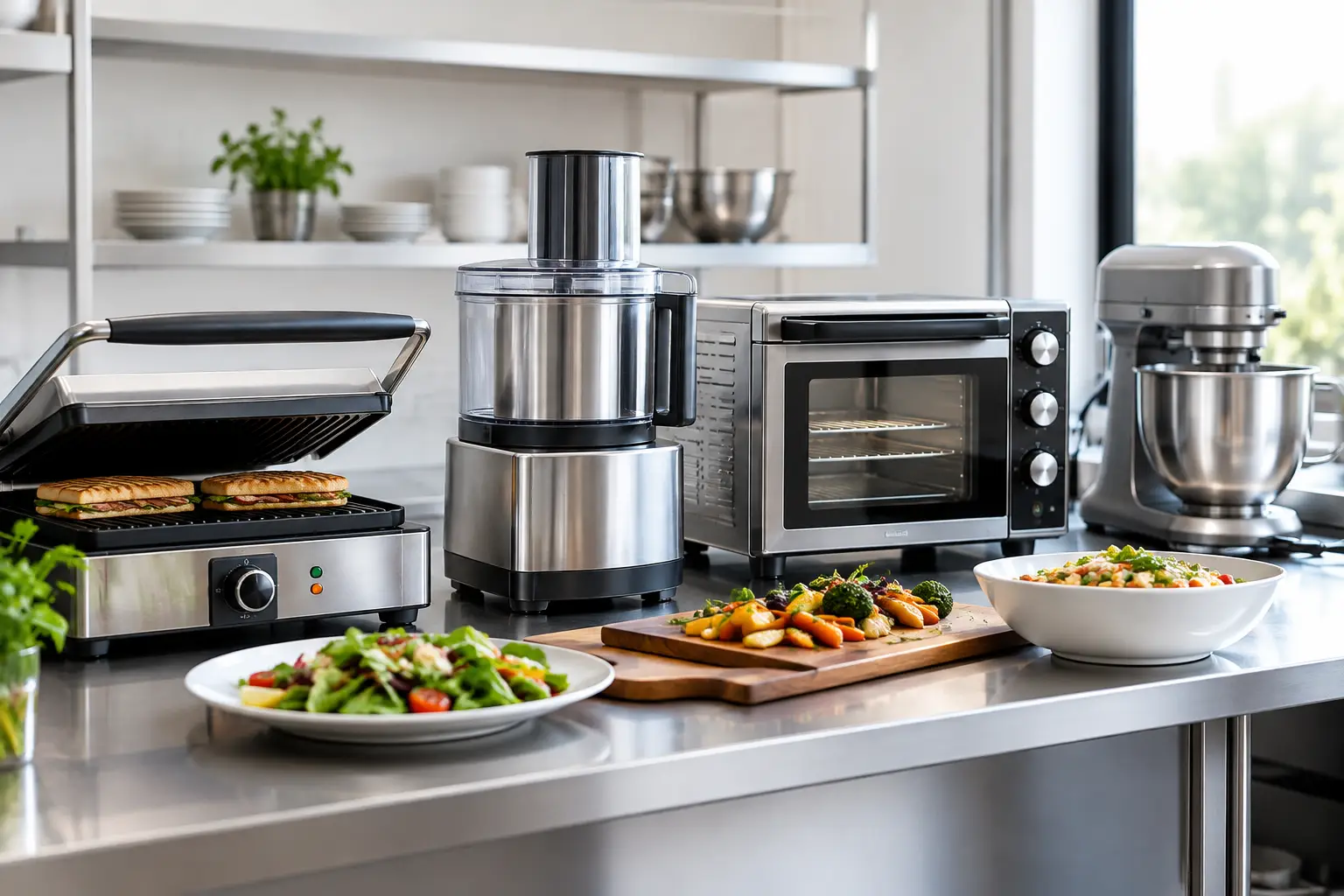
A crowded pass, a short service window and one power point in the wrong place can quickly expose weak equipment choices. The best benchtop catering appliances are not simply the smallest or cheapest units on the shelf. They are the machines that suit your menu, service volume, available bench space and utilities without creating bottlenecks for the team.
For cafés, takeaway shops, caterers, pubs, clubs and institutional kitchens, benchtop equipment can be a smart way to add production capacity without a full kitchen rebuild. The key is buying commercial-grade appliances that will earn their footprint every day.
What makes the best benchtop catering appliances?
“Best” depends on what you need the appliance to do during your busiest hour. A compact contact grill may be ideal for a café producing toasted sandwiches all morning, but it will not replace a high-output griddle in a takeaway shop with a lunch rush. Likewise, a benchtop fryer can be an efficient addition to a bar menu, while a larger floor fryer may be the better long-term purchase for fish and chips or fried chicken.
Start with the menu and work backwards. Identify which items take the longest, require the most staff attention or hold up the pass. That is usually where an appliance can make the greatest difference. If a chef is tied up finishing burgers in a pan, a commercial griddle may lift consistency and speed. If reheating, baking and small-batch roasting are slowing preparation, a benchtop convection oven may carry more value than another hotplate.
Capacity matters, but recovery time matters just as much. A fryer with a modest oil capacity can still perform well if it recovers temperature quickly between batches. A grill with a large plate is only useful if its power output can maintain heat when cold food lands on it. Check both the stated capacity and the output rating before comparing prices.
Choose equipment around the way you serve food
Benchtop appliances work best when they are selected as part of a workflow, not as isolated purchases. Think about where food enters the kitchen, where it is prepared, cooked, held and plated. A good machine in the wrong position can add unnecessary movement and slow the whole team down.
Contact grills and sandwich presses
A commercial contact grill is a practical choice for cafés, delis, hotel kitchens and takeaway counters with toasted sandwiches, wraps, paninis or breakfast items on the menu. Look for strong thermostatic control, durable plates and enough cooking area to handle peak periods without making customers wait.
Flat plates are easier to clean and suit delicate breads, while ribbed plates add grill marks and can help render fat away from some products. Many operators choose a combination of flat and ribbed plates for menu flexibility. Consider plate material as well. Cast iron holds heat well, while other surfaces may suit kitchens prioritising faster cleaning or lower-maintenance operation.
Griddles, hotplates and chargrills
Benchtop griddles are among the most useful additions to a busy cook line. They suit eggs, bacon, burgers, seafood, vegetables, steaks and breakfast service, making them a sensible option when menus change throughout the day. Gas models can offer responsive heat and may suit venues already set up for gas. Electric units can be easier to position where gas is unavailable, provided the electrical supply is adequate.
Plate thickness is worth checking. A heavier plate usually retains heat better, particularly when several orders are loaded at once. It may take longer to heat up, but it can produce more stable results in service. A thinner plate may be suitable for lower-volume use, but can struggle under constant demand.
Chargrills bring a different finish and flavour, but they also need proper ventilation, clearance and cleaning. Do not buy one simply for its compact footprint. Confirm that your extraction system, fire protection arrangements and bench layout can support it.
Benchtop fryers
A fryer can be one of the highest-earning appliances in a commercial kitchen, but only when its size matches demand. For chips, sides and occasional fried menu items, a single-tank benchtop fryer may be sufficient. For venues cooking multiple products, twin baskets or separate tanks help prevent flavour transfer and make it easier to manage service.
Prioritise temperature recovery, easy oil drainage and accessible components for cleaning. A fryer that is difficult to filter or drain is more likely to be neglected, which affects food quality and shortens oil life. Also allow room for safe loading, basket lifting and a suitable landing area for cooked food.
Benchtop ovens and combi-style cooking
Compact commercial ovens can do far more than reheat food. Depending on the model, they can bake pastries, roast proteins, finish dishes, regenerate plated meals and support catering prep. They are especially useful where a full-size oven is unavailable or where production needs to be spread across several stations.
Before purchasing, check tray size, internal clearance, temperature range and door swing. A small oven with an awkward tray format may create more work than it saves. If you are considering a compact combi-style unit, factor in water supply, drainage, filtration and staff training. The extra cooking control can be worthwhile, but only if the site is ready for it.
Food warmers and bain-maries
For buffets, functions, carveries, school canteens and high-volume service, benchtop food warmers and bain-maries help protect consistency at the finish line. They are designed to hold cooked food at serving temperature, not to cook it from cold or bring it rapidly up to temperature.
Choose the pan configuration around your actual menu. A venue serving sauces and sides may need several smaller gastronorm pans, while a catering operation might need deeper pans for bulk portions. Wet and dry heat options each have a place, but the important point is to maintain safe holding temperatures and avoid drying food out during service.
Check your site before you commit
The appliance is only part of the purchase. Measure the bench, nearby clearance and the access route into the kitchen. Check whether the unit will sit under existing extraction, whether a splashback is required and whether there is enough room for cleaning around it. A benchtop unit still needs a stable, heat-resistant commercial work surface, not an improvised corner of the prep bench.
Power is another common issue. Some equipment runs from a standard 10-amp outlet, while higher-output electric appliances may need dedicated circuits, 15-amp connections or three-phase power. Gas appliances need suitable connection, commissioning and ventilation arrangements. Confirm these details before delivery, not when the installer is standing in the kitchen.
For Australian commercial operations, food safety, ventilation, fire safety and local compliance requirements must also be considered. Requirements can vary by site and council area, especially when gas, deep frying or grease-laden vapours are involved. If you are fitting out a new kitchen or changing the cooking line, get advice early.
Balance upfront price with operating value
A low purchase price can look attractive, especially for a new venue managing fitout costs. However, the cheapest appliance may cost more if it has slow recovery, limited output, difficult cleaning or poor access to parts. Buying branded commercial equipment with warranty support can reduce downtime when you need the machine most.
That does not mean every kitchen needs the most expensive model. A smaller café with a focused menu may be better served by a simple, dependable grill rather than a feature-heavy unit it will never fully use. Pre-owned commercial equipment can also offer excellent value when it has been assessed carefully and suits the job.
Ask practical questions before buying: How many serves can this appliance realistically produce in a peak hour? What utility connection does it need? How easy is it to clean at close? Are replacement parts and service support available? What warranty applies? These answers are more useful than comparing dimensions alone.
CKE Sydney can assist operators sourcing individual benchtop units or planning a wider kitchen upgrade, with new and quality pre-owned options, equipment advice, finance availability and Australia-wide delivery.
Give your new appliance a fair start
Once the equipment arrives, set it up properly. Train staff on warm-up times, loading limits, temperature settings, cleaning and daily checks. Keep the manufacturer instructions available and build cleaning into the close-down routine from day one. A well-chosen benchtop appliance should make service calmer, not add another problem for the team to manage.
The right purchase is the one that removes pressure at your busiest point of service. Bring your menu, site measurements and expected covers to the conversation, and you will be far more likely to buy equipment that keeps paying its way long after opening week.