
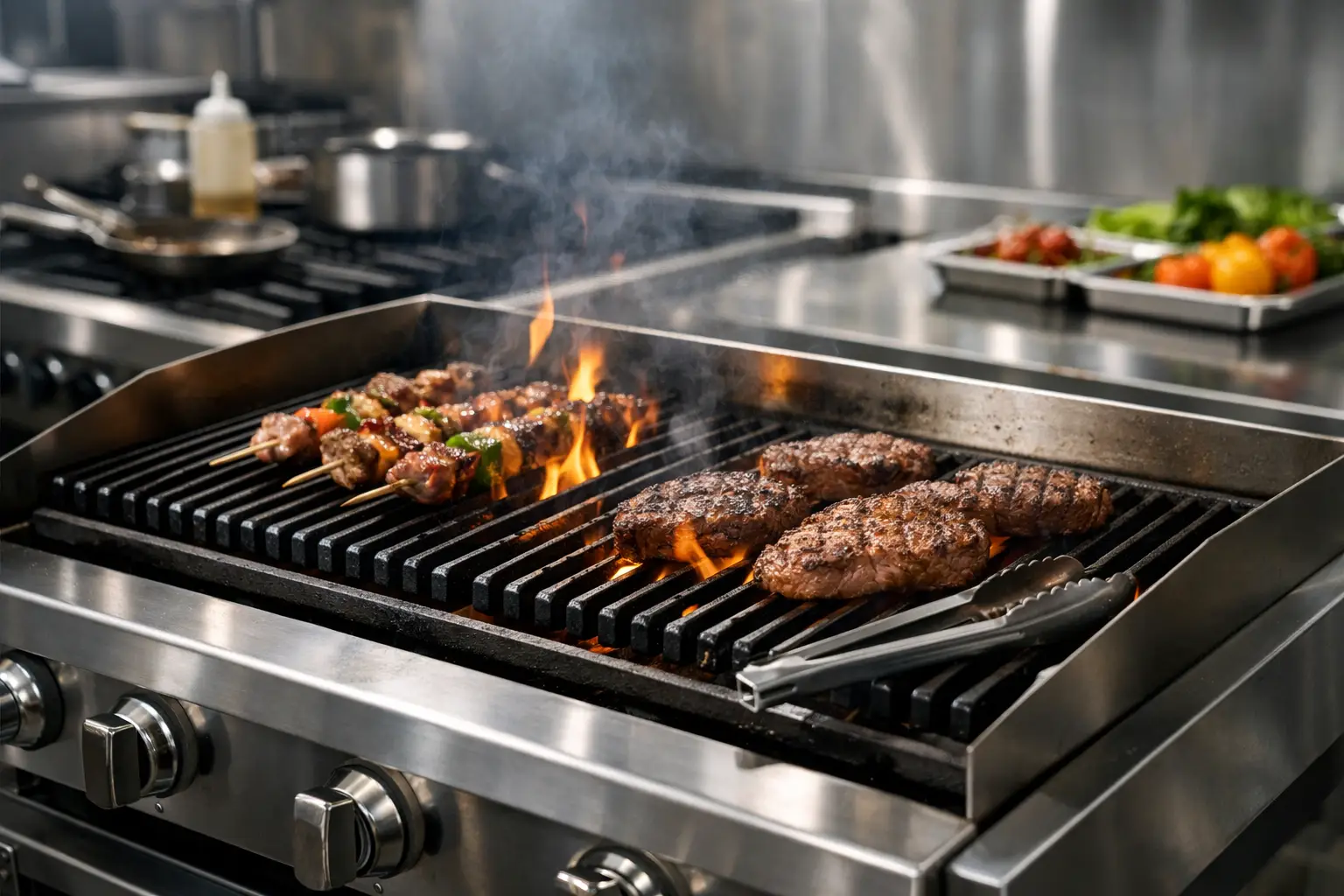
A commercial char grill can be the difference between a grill section that keeps service moving and one that leaves cooks waiting for heat to recover. For restaurants, pubs, cafés, takeaway shops and caterers, it is not simply a matter of putting char marks on steak. The right unit needs to handle your busiest covers, suit your menu, work safely under your canopy and stand up to daily cleaning.
Char grills are a strong fit where flame-grilled flavour and an open cooking surface are central to the offer. Think steaks, burgers, chicken, seafood, skewers, vegetables and breakfast items. Before choosing a model, assess how the grill will work during a real Saturday-night service, not just how it looks on a spec sheet.
Start With Your Menu and Peak Service
The first question is what the grill must produce in its busiest 15 to 30 minutes. A small café may only need space for a few breakfast proteins and grilled sandwiches at once. A steak restaurant, sports bar or busy burger venue may need enough grate area to cook dozens of portions while retaining a hot zone for searing and a cooler area for finishing.
Plate width matters, but usable cooking space matters more. Allow room to turn product, move food away from flare-ups and hold items briefly without crowding the grate. If every inch is packed with protein, staff will struggle to control doneness and consistency.
Also consider the products you cook most often. High-fat burgers, sausages and marinated chicken create more drippings than lean beef or vegetables. A char grill designed with effective grease collection, durable radiants or lava rock support and easy access for cleaning will make a noticeable difference at close-down.
For venues with a broad menu, it can be practical to pair the grill with a flat griddle, fryer or range rather than expecting one appliance to do every job. Char grills excel at open-flame flavour and high-heat cooking, while a griddle gives more control for eggs, onions, delicate fish and sauces.
Gas, Electric and Fuel Choices
Gas char grills remain a popular choice in commercial kitchens because they heat quickly, offer dependable output and are straightforward for cooks to control. Natural gas can suit fixed sites with an existing supply, while LPG may be appropriate where reticulated gas is unavailable. Your gas type must be confirmed before ordering, as conversion is not always simple or economical.
Electric char grills can be useful where gas restrictions, site infrastructure or ventilation arrangements rule out gas. They may deliver a more controlled cooking environment, but recovery time, operating costs and the style of char achieved should be considered against your menu. For a venue selling a classic flame-grilled steak or burger experience, gas is often the more natural fit.
Traditional charcoal equipment provides genuine solid-fuel flavour, but it brings higher ventilation, fire safety, ash handling and cleaning demands. It may be worthwhile for a premium open-kitchen concept, yet it is rarely the simplest option for a fast-paced operation with limited back-of-house space.
Whatever fuel source you choose, check the manufacturer’s stated gas consumption or electrical load and compare it with your site capacity. A high-output unit only performs as intended when the supply, extraction and installation are properly planned.
Selecting the Right Commercial Char Grill Size
Bench-top char grills suit smaller kitchens, food trucks, cafés and venues that need a dedicated grilling station without giving up a full cooking suite. They can also be useful as an additional finishing grill when a venue’s main line is already established. Make sure the bench underneath is suitable, stable and positioned to meet clearance requirements.
Freestanding units are often a better choice for high-volume restaurants, pubs and clubs. They generally provide greater cooking area and can integrate neatly with matching fryers, griddles and gas ranges. This creates a continuous cookline, gives staff a more organised workflow and makes use of the available canopy space.
Do not buy larger simply because it seems safer. An oversized char grill uses more floor space, can increase gas consumption and may create unnecessary cleaning work during quiet periods. On the other hand, buying too small is expensive in a different way: longer ticket times, reduced output and pressure on staff every time the venue fills up.
Measure the full route before purchase, including doors, corners, lifts, loading access and the final cooking line. For refurbishment projects, consider whether existing benches, splashbacks and exhaust systems will need changes. This is where an equipment supplier with kitchen design and fitout experience can help prevent a costly mismatch.
Build Quality That Holds Up During Service
Commercial kitchens need equipment made for repeated heating, cooling, scrubbing and heavy use. Look for stainless-steel construction, strong welded frames where applicable, solid control knobs and grates that can take the weight of commercial cookware and regular handling.
Cast-iron grates are valued for heat retention and pronounced grill marks. They need consistent seasoning and care to reduce sticking and surface deterioration. Stainless-steel grates are generally easier to maintain and can be a practical option in operations where several staff share cleaning duties. There is no single best choice. It depends on the finish you want, your cleaning routine and how disciplined the team is with maintenance.
Heat distribution is equally important. Good burner layout and quality radiants help reduce cold spots across the cooking surface. Some variation is useful because cooks can create working zones, but extreme hot and cool patches make it harder to produce consistent food.
Check how easily staff can remove grates, radiants and drip trays. If daily cleaning requires excessive dismantling, it will eventually be rushed. A grill that is simple to clean is more likely to remain efficient, hygienic and safe.
Ventilation, Compliance and Installation
A char grill produces heat, smoke and grease-laden vapour, especially when cooking fatty proteins at high temperature. It needs to sit beneath a correctly designed commercial exhaust canopy with adequate extraction. The canopy, ducting, filters and make-up air system should be assessed as a complete setup, not treated as separate purchases.
Gas installation must be carried out by a licensed professional, and electrical work must be completed by a qualified electrician. Requirements can vary by site, building rules, insurer, local council and the relevant Australian standards. Confirm clearances to combustible surfaces, fire suppression needs, gas isolation access and equipment positioning before delivery day.
A new grill may also affect the capacity of your existing exhaust system. If you are replacing a light-duty appliance with a high-output char grill, the current canopy may not be sufficient. Addressing that early is far less disruptive than finding out after the equipment has arrived.
Budget for Ownership, Not Just the Purchase Price
The lowest upfront price is not always the lowest operating cost. Consider output, gas use, expected lifespan, warranty cover, replacement parts availability and how much labour is required to clean and maintain the unit. A well-built branded grill can make more commercial sense when it reduces downtime during a busy trading period.
Pre-owned commercial equipment can offer good value for operators fitting out on a tighter budget, provided its condition, gas type, dimensions and serviceability are checked carefully. It may be ideal for a secondary cooking station or a new business managing start-up costs. For a high-volume core line, many operators prefer new equipment with a full warranty and known service history.
Finance may also help a venue install the right capacity from the start rather than compromising on a unit that will be outgrown quickly. CKE Sydney can assist operators sourcing individual cooking equipment or planning a wider kitchen upgrade, from the grill line through to refrigeration, preparation benches and wash-up equipment.
Keep Performance Consistent With Daily Care
A char grill should be cleaned while it is still warm enough for residue to release safely, following the manufacturer’s instructions. Brush the grates, empty and clean grease trays, remove food debris and inspect burner areas regularly. Avoid allowing grease to build up around radiants or below the cooking surface, where it can cause smoke, flare-ups and poor heat performance.
Train every relevant staff member on lighting, shut-down, temperature control and cleaning. Good equipment cannot compensate for inconsistent operation. A simple close-down checklist is usually enough to protect the grill and make the next service easier.
Choose a char grill that suits the way your kitchen actually trades, leave room for safe installation and give staff a unit they can clean properly at the end of a hard shift. That practical decision will show up in faster service, more consistent food and fewer headaches when the docket rail is full.