
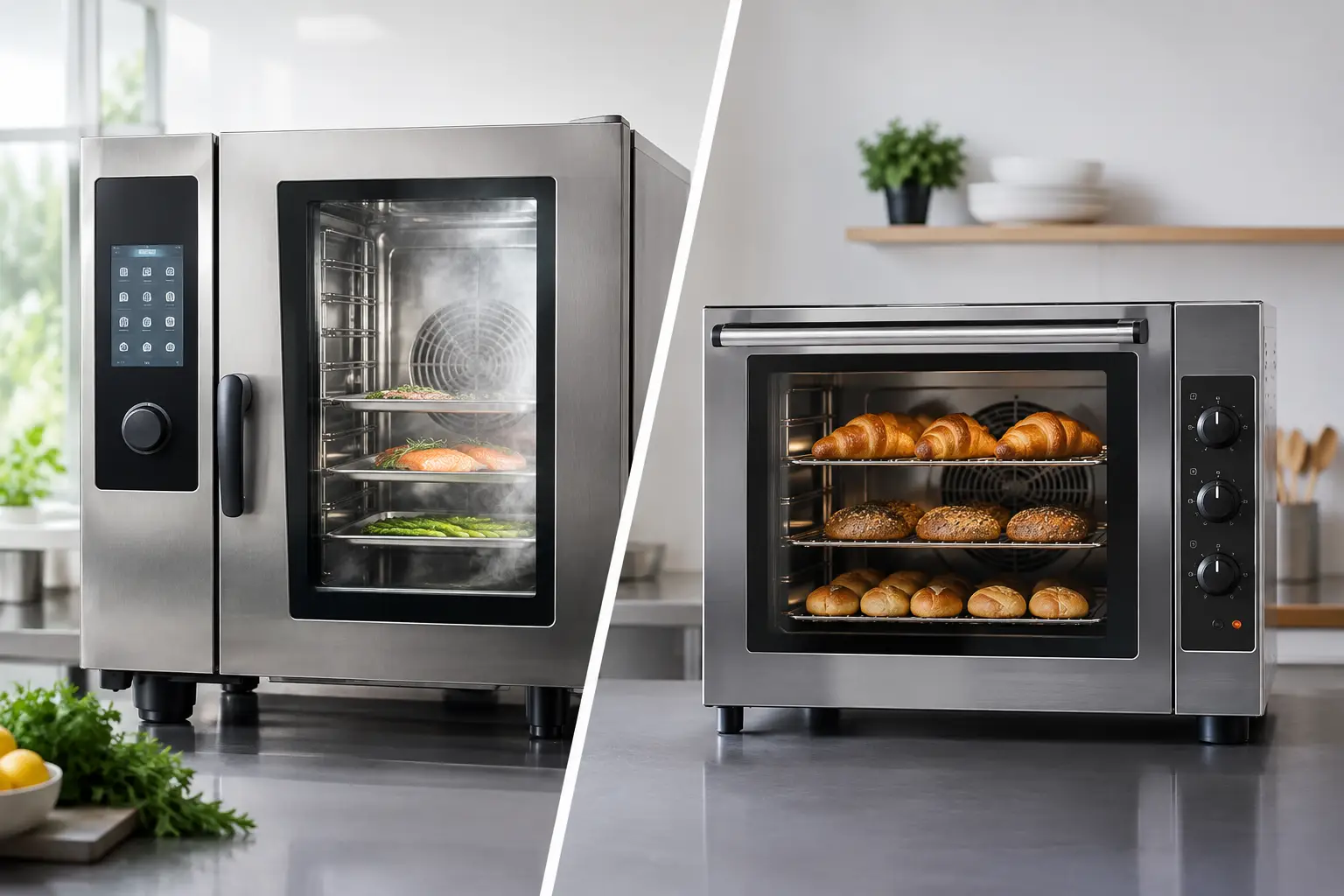
A busy lunch service quickly exposes the limits of the wrong oven. If your team is juggling roast vegetables, baked fish, reheated meals and a tray of pastries, the combi oven versus convection oven decision affects more than cooking results. It affects labour, menu flexibility, food yield, bench space and how reliably your kitchen gets through peak periods.
Both ovens earn their place in commercial kitchens across restaurants, cafés, pubs, clubs, caterers and aged-care facilities. The better choice depends on what you cook, how much you produce and whether consistency or versatility is your biggest pressure point.
Combi Oven Versus Convection Oven: The Working Difference
A convection oven cooks with dry, circulating heat. Its fan moves hot air around the cabinet, helping food cook more evenly and often faster than in a conventional static oven. It is a familiar, practical choice for baking, roasting, reheating and general-purpose tray work.
A combi oven combines three cooking modes in one cabinet: dry convection heat, steam, and combination cooking that uses heat and steam together. This gives chefs far more control over humidity during the cook. Instead of simply roasting a chicken at a set temperature, for example, you can use moisture to protect the product early in the cycle and finish with dry heat for colour and crisp skin.
That extra capability is the central difference. A convection oven is generally simpler and lower cost. A combi oven is designed to take on a broader range of production tasks with more precise control.
Where a Convection Oven Makes Commercial Sense
For many operators, a convection oven is the right tool because it does the required job without adding unnecessary cost or complexity. It works particularly well where the menu relies on dry-heat cooking and batches are relatively straightforward.
Bakeries and cafés can use a convection oven for muffins, slices, pastries, biscuits and savoury pies. Takeaway shops may rely on one for roasting vegetables, cooking trays of chicken, finishing baked pasta dishes or reheating prepared products. In a pub or bistro, it can be a dependable second oven that keeps sides, desserts and smaller functions moving while the main cooking line handles service.
The airflow promotes even browning, but it can also dry delicate foods if staff do not adjust temperatures and cooking times. Cakes, custards, fish and lean meats need closer attention than they would in a humid cooking environment. A skilled cook can achieve excellent results, but there is less room to manage moisture.
Convection ovens are also usually easier to train staff on. Controls are often direct, cleaning requirements are simpler, and installation may be less involved than a combi model. For a small café, a new takeaway venue or a kitchen replacing an ageing oven on a tight budget, that simplicity can be a strong advantage.
Best fit for a convection oven
Choose a convection oven when your core work is baking, roasting and reheating; you have limited water and drainage access; your team needs uncomplicated controls; or capital cost is the deciding factor. It is not a lesser oven. It is a focused oven that suits a focused menu.
Why Many High-Volume Kitchens Choose a Combi
A combi oven earns its higher upfront cost through flexibility and repeatability. Steam cooking can produce vegetables with better colour and less shrinkage, cook rice or grains in bulk, and handle seafood or delicate proteins more gently. Combination mode is useful for roasts, poultry, baked dishes and regenerating plated or bulk-prepared meals.
For caterers, hotels, clubs and institutional kitchens, that versatility can reduce the need for separate steaming, roasting and regeneration equipment. Instead of shifting trays between appliances, staff can programme a cooking cycle and use the same cabinet through different stages of production.
Food yield is often a major commercial benefit. Moisture loss during cooking means less saleable product. When you are roasting batches of meat or producing meals at scale, better humidity control can help protect weight, texture and appearance. The result is more consistent portions and fewer complaints about dry chicken, overcooked fish or tired reheated meals.
Combi ovens also support repeatable programmes. Once a chef has set a reliable process for a particular product, the cycle can be saved for other staff to follow. This is useful in multi-shift operations, venues with frequent casual staff, and sites where the head chef cannot personally oversee every batch.
A combi is not automatically the right answer for every kitchen. Its controls and functions require proper staff training. It needs a suitable water supply, filtration and drainage arrangement, and regular cleaning is non-negotiable. Water quality matters as well. Scale build-up can affect performance and lead to avoidable servicing costs, so follow the manufacturer’s requirements from day one.
Best fit for a combi oven
A combi oven suits menus with varied production, high volumes, frequent roasting or regeneration, and dishes where moisture control protects quality. It is especially worth considering when you are fitting out a new commercial kitchen and can plan services, workflow and extraction around the equipment from the start.
Capacity Is More Than Tray Numbers
It is tempting to compare ovens only by the number of trays they hold. Tray capacity matters, but it is not the whole picture. Consider the size and type of trays, the clearance between shelves, the volume you need at your busiest hour and whether the oven must cook different products at the same time.
A compact six-tray convection oven may be plenty for a café baking morning stock and warming lunch items. A ten-tray or twenty-tray combi may make more sense for a function venue producing hundreds of covers, or an aged-care kitchen working to scheduled meal times.
Also consider where the oven sits in the flow of the kitchen. Staff need room to load hot trays safely, move trolleys where relevant, access ingredients and plate or hold food without crossing the wash-up path. A larger oven that blocks the pass or creates a bottleneck is not a productivity upgrade.
Purchase Price, Running Costs and Maintenance
The purchase price is usually the first difference operators notice. A convection oven is generally more affordable to buy and can be a sensible way to get reliable cooking capacity into a new venue. A combi oven costs more because it includes steam generation, humidity management, more advanced controls and, often, automated cleaning features.
The right comparison is the total cost over the oven’s working life. If a combi replaces separate steaming equipment, shortens cooking cycles, improves yield and reduces rework, the higher initial spend may be justified. If your kitchen only bakes trays of pastries and reheats pies, those benefits may not be used enough to warrant the extra investment.
Energy use also depends on how the oven is operated. Avoid buying more capacity than you can sensibly fill. Running a large cabinet for a few trays wastes energy, regardless of oven type. Good loading practices, regular door seal checks, correct preheating and scheduled cleaning all help protect efficiency.
Maintenance should be part of the decision, not an afterthought. Combi ovens need appropriate water treatment, drainage and preventative care. Convection ovens still need cleaning, fan checks, seals and servicing, but their systems are generally less complex. Ask about warranty coverage, available parts and service support before you commit, particularly if the oven will be central to every service.
Questions to Ask Before You Buy
Start with your actual menu, not the feature list. How many portions do you produce in a peak hour? Which dishes currently cause delays or inconsistent results? Do you need to cook, steam and regenerate from one position, or do you simply need more reliable baking and roasting capacity?
Next, check your site services. Confirm electrical supply, gas requirements where applicable, water pressure and quality, drainage, ventilation, access dimensions and the path from delivery point to kitchen. A good oven choice can become an expensive problem if it cannot be installed correctly.
Finally, think about who will use it. A programmable combi can make output more consistent across a larger team, but only if staff are trained to load it correctly, select the right programme and complete the cleaning cycle. A straightforward convection oven may be the better operational choice where the menu is simple and turnover is high.
For operators planning a full fitout or replacing a key appliance, CKE Sydney can help match oven capacity and features to the rest of the cooking line, rather than selling a cabinet in isolation. New and quality pre-owned options can also change what is achievable within the available budget.
The most useful oven is the one that keeps your food quality steady when orders stack up. Bring your menu, production targets and site details into the buying conversation, then choose the equipment that makes the next busy service easier to run.