
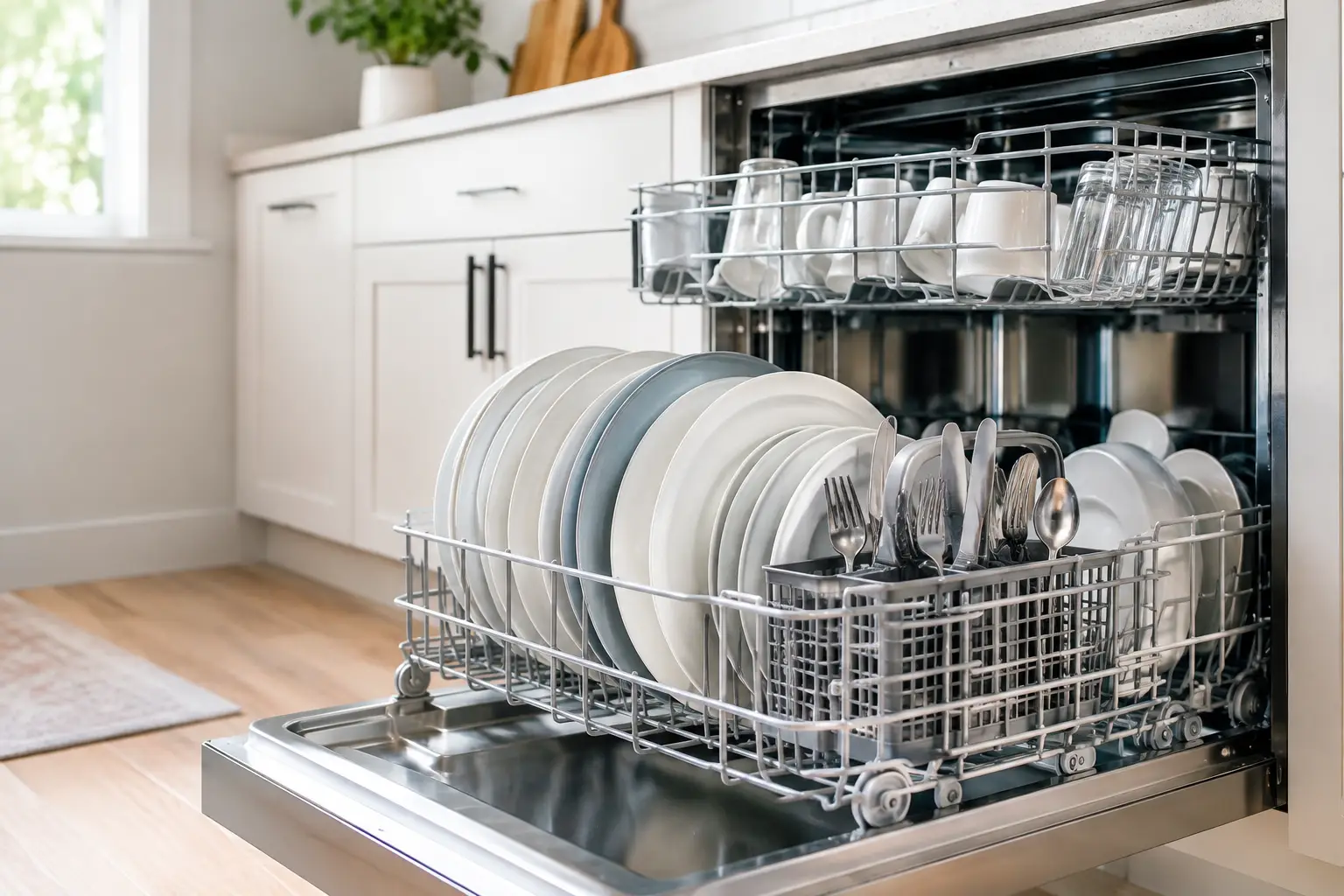
A commercial dishwasher can look like a straightforward purchase until the wash-up area backs up at the end of service. Dishwasher rack capacity is one of the details that determines whether plates return to the floor quickly or staff are left stacking soiled crockery on every spare bench. For cafés, restaurants, pubs, clubs, caterers and institutional kitchens, the right capacity protects service speed, hygiene standards and labour costs.
The key is not simply buying the dishwasher with the highest quoted rack count. You need to match the machine, rack type and wash-up workflow to what your kitchen actually produces in a busy hour.
What dishwasher rack capacity really means
In commercial warewashing, capacity is usually expressed as racks per hour. Most undercounter, pass-through and conveyor dishwashers use a standard 500 x 500 mm rack, although the number of items in each rack varies considerably. A plate rack may hold 18 dinner plates, while a glass rack may hold 25 to 49 glasses depending on their diameter and shape.
That means a machine rated at 40 racks per hour does not automatically wash 40 racks of the same load. It may process 720 standard plates an hour when fully loaded, but fewer oversized pizza plates, bowls, trays or pots. The rated figure is also based on an ideal cycle with racks ready to load, correct water temperature and no interruption for scraping, sorting or unloading.
For purchasing purposes, treat racks per hour as the starting point rather than the final answer. A realistic capacity calculation considers the items being washed, the peak period, available staff and how much space there is to manage clean and dirty racks.
The standard rack is only part of the equation
A 500 mm rack is common because it works across a wide range of commercial dishwashers and gives operators flexibility to use plate, glass, cutlery and open racks. However, the rack has to suit the ware. Glass racks with compartment dividers reduce breakages but may hold fewer items. Peg racks for plates need the right spacing so crockery is properly exposed to wash water. Open racks are useful for utensils, containers and odd-shaped items, but loads must be arranged carefully to avoid water pooling.
Before selecting equipment, measure the largest plates, bowls, trays and glassware your venue uses. Also consider future menu changes. A venue moving into share plates, larger bowls or takeaway packaging may find a tightly specified rack layout restrictive surprisingly quickly.
Calculate dishwasher rack capacity from peak demand
The busiest 30 to 60 minutes is more useful than an average daily cover count. A 70-seat restaurant may serve 180 guests across dinner, but if most tables turn over within a short window, the dishwasher needs to cope with that concentrated load. The same applies to a café with a heavy breakfast rush or a pub where glassware demand spikes between 5 pm and 7 pm.
Start by counting the items used per cover. For a plated restaurant meal, that may include an entrée plate, main plate, dessert plate, side plate, cutlery, water glass and wine glass. Not every item reaches the wash-up area at exactly the same time, but it gives a reliable sense of the load.
Then estimate the peak number of covers or drinks served in an hour. Divide the required item count by what each correctly loaded rack can hold. This gives the number of racks that must be washed during the peak, not across the whole trading day.
For example, if a restaurant needs to wash roughly 360 dinner plates in its busiest hour and its plate rack holds 18 plates, that is 20 plate racks before glasses, cutlery and kitchen utensils are considered. A 40-rack-per-hour machine may appear sufficient, but the result depends on whether the wash-up team can maintain short cycles and whether glassware creates an additional 15 racks in the same period.
Allow headroom. Selecting capacity that only just meets a theoretical peak leaves no room for a delayed collection, a large booking, staff breaks or a recovery wash for heavily soiled items. In practical terms, choosing a machine with at least 20 to 30 per cent more usable capacity than the calculated peak is often the safer commercial decision.
Match the dishwasher type to the operation
Undercounter dishwashers
An undercounter dishwasher suits smaller cafés, takeaway shops, bars and low-volume service areas where space is tight. Many models run around 20 to 40 racks per hour, depending on cycle settings. They are compact and convenient, but staff must bend to load and unload, and there is limited room for staging racks around the machine.
An undercounter unit can be a sensible value choice when most washing happens steadily through the day. It is less suitable where a full dining room clears at once, or where the same machine is expected to handle breakfast crockery, bar glasses and prep equipment without a planned workflow.
Pass-through dishwashers
Pass-through or hood-type dishwashers are a common choice for busy restaurants, clubs, hotels and catering kitchens. Racks slide through at bench height, allowing a dirty-side and clean-side flow. This reduces handling and makes it easier for two staff members to work without getting in each other’s way.
These machines typically offer stronger throughput than undercounter models and are easier to integrate with inlet benches, outlet benches and drying areas. They do need adequate clearance for the raised hood and enough floor space for staff movement. Buying a fast pass-through machine without room to stage racks will still create a bottleneck.
Conveyor and flight-type systems
High-volume hospitals, aged-care facilities, large clubs, event venues and production kitchens may need a conveyor dishwasher. These systems are designed for continuous operation, moving racks through wash and rinse zones with far less manual handling per item.
The upfront investment, installation requirements and utility demand are greater, but the labour and throughput benefits can be substantial at scale. They make little sense for a small venue with occasional peaks, yet may be essential where hundreds of meals are cleared in a short service period.
Capacity depends on the whole wash-up area
A dishwasher cannot perform at its quoted rack rate if the surrounding area is poorly planned. Dirty crockery needs a landing area, scraps need to be removed, racks need to be loaded properly, and clean items need somewhere hygienic to air dry. When these steps compete for the same small bench, the machine sits idle between cycles.
A practical layout separates the dirty and clean sides. Dirty racks should move from clearing point to scrape area, pre-rinse and dishwasher in one direction. Once washed, clean racks should move away from food waste and splash zones toward drying and storage. This is easier to achieve with correctly sized stainless-steel benches and rack storage than by relying on staff to improvise during service.
Water supply, drainage, ventilation and power also matter. A machine that waits for water to recover temperature, drains slowly or trips because its electrical supply is underspecified will not achieve its intended capacity. Confirm site services before purchase, particularly when replacing an older unit with a faster model.
Common capacity mistakes that cost time
The most common mistake is selecting by price alone. A lower-cost machine can be excellent value if it matches the job, but it becomes expensive when staff spend every peak period rerunning loads or hand-washing items to catch up.
Another is counting plates but ignoring glassware. Bars, pubs and functions can generate more racks of glasses than plates, and glass racks take longer to load with care. Caterers also need to account for gastronorm pans, serving utensils and transport equipment, which can consume rack space quickly.
Operators sometimes use long cycles as the default to deal with poor pre-rinsing or unsuitable chemicals. Longer cycles reduce actual rack output. Better scraping, correct detergent and rinse aid, appropriate water treatment and routine cleaning can often improve wash quality without sacrificing throughput.
Finally, do not forget storage. Buying extra racks is usually worthwhile, but only if there is somewhere clean and accessible to keep them. Separate racks for plates, glasses and cutlery help the team load consistently and avoid stopping mid-service to unload a mixed rack.
Choosing capacity with confidence
When comparing commercial dishwashers, bring real figures: peak covers, bar trade, item sizes, wash-up space, available utilities and the number of people working the area. A good equipment supplier should turn those details into a practical recommendation, not just point to the largest rack-per-hour number on a specification sheet.
CKE Sydney can assist operators planning a complete kitchen fitout or replacing a machine that no longer keeps up. The right choice may be a compact undercounter unit with better rack management, a pass-through dishwasher with proper benches, or a higher-output system that prevents costly service delays.
Give your wash-up area enough capacity to recover from the rush, not merely survive it. When racks move steadily, staff can focus on service and clean crockery is ready when the next table needs it.