
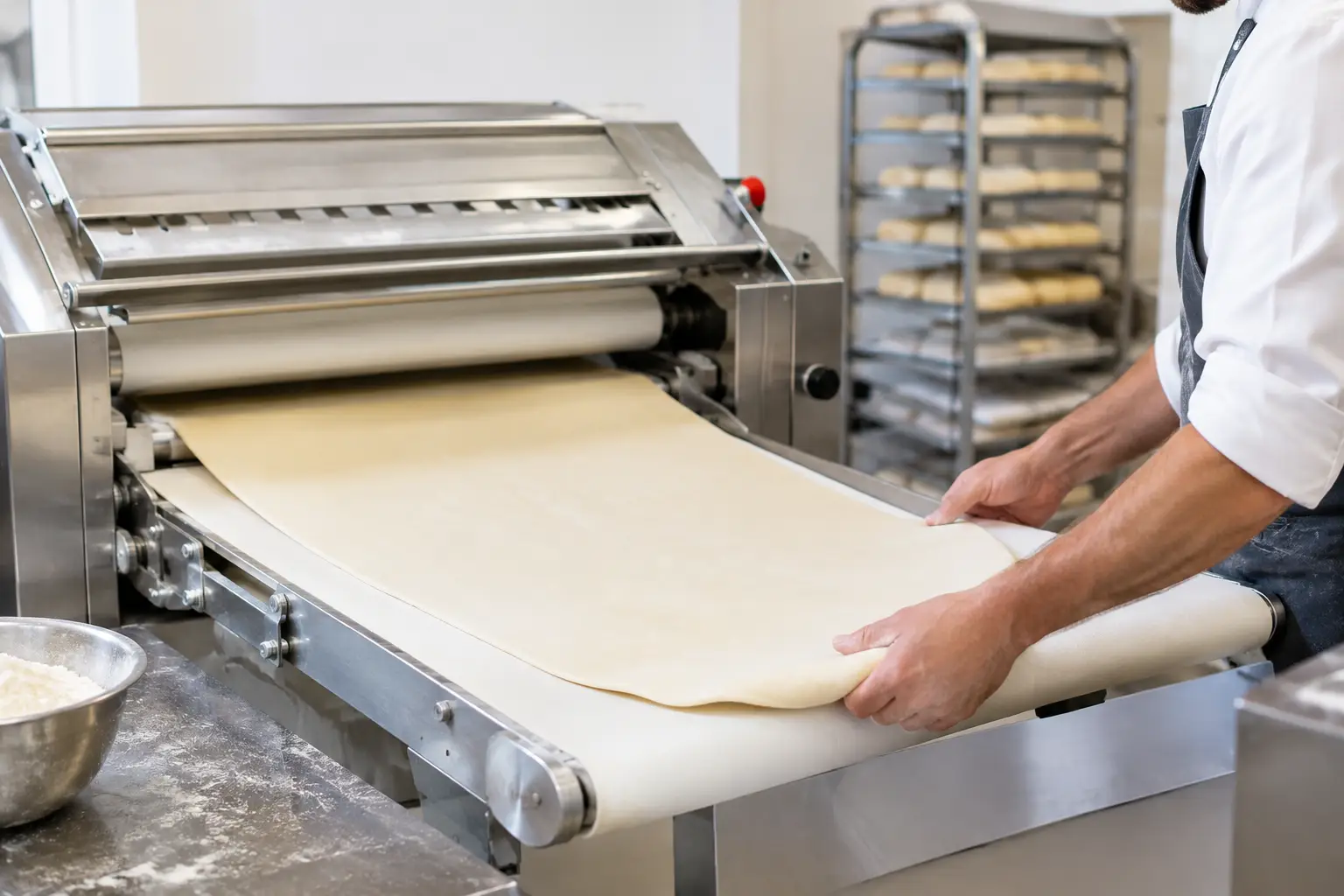
A busy pastry bench can lose hours each week to hand rolling, inconsistent thickness and reworking dough that has been overworked or torn. Dough sheeters give bakeries, pizzerias, cafés and caterers a practical way to produce even sheets quickly, helping staff maintain product quality through a busy service or production run.
For a small venue, a sheeter may mean one person can prepare pizza bases, pie pastry and laminated dough without holding up the rest of the prep list. For a bakery or central production kitchen, it can create the consistency needed across hundreds of croissants, danishes, tart shells or pastry sheets. The right machine is not simply about getting dough flat. It is about matching output, available space and the products your kitchen actually sells.
Choosing dough sheeters for your operation
A dough sheeter uses adjustable rollers to reduce dough to a controlled thickness. Instead of relying on rolling pins and staff judgement, the operator feeds dough through the machine, adjusts the roller gap in stages and receives a consistent sheet ready for cutting, filling, folding or shaping.
That consistency matters commercially. Uneven pastry can bake at different rates, pizza bases can vary in portion size, and laminated dough can lose its defined layers when it is handled too much. A good sheeter helps reduce those variables. It can also reduce staff fatigue during high-volume prep, particularly where dough is dense, chilled or repeatedly rolled.
The best choice depends on your menu. A pizza shop producing standard round bases may need a compact bench unit that fits beside the mixer and prep fridge. A patisserie making croissants and puff pastry will generally need a reversible floor-standing machine with long tables, allowing the dough to be rolled out and folded repeatedly. Caterers may prioritise a model that can be moved or folded away between functions, while an institutional kitchen may focus on simple controls, durability and easy cleaning.
Bench-top, floor-standing and reversible models
Bench-top sheeters are a sensible option where floor area is tight and daily volume is modest. They suit many cafés, small bakeries, takeaway shops and pizza venues. Before buying, measure the bench properly, including clearance around the machine for operators to load and receive dough. A sheeter that technically fits but blocks a prep path will become a daily frustration.
Floor-standing models are built for heavier production. Their larger conveyor tables support wider sheets of dough and give the operator more working room. They are commonly used for pastries, pie dough, croissants, danishes and other laminated products. The trade-off is footprint. A full-size reversible sheeter needs clear space at both ends of the conveyor, not just the space directly underneath the unit.
Reversible sheeters are particularly useful for laminated dough. The conveyor changes direction, moving the dough back and forth through the rollers so it can be gradually reduced, folded and turned without excessive manual handling. This is a more capable setup for bakeries, but it may be unnecessary for a venue only pressing pizza dough or rolling occasional shortcrust pastry.
Some models feature folding tables to reduce their footprint when not in use. This can work well in a multipurpose kitchen, although staff still need enough room to safely open the tables during production. Always plan around the machine in operating position, not storage position.
Capacity is more than dough weight
It is tempting to compare dough sheeters by maximum dough weight alone. That figure is useful, but it does not tell the full story. Roller width, conveyor length, roller gap range, motor performance and the type of dough all affect usable output.
A wider roller allows larger sheets and may reduce the number of passes required for tray-sized pastry. A longer conveyor gives more support for larger dough pieces, especially during lamination. Fine roller-gap adjustment is valuable when products require specific final thicknesses, such as puff pastry, filo-style preparations or precise pizza bases.
Consider the volume you need during your busiest period, rather than your average Tuesday. If your bakery makes pastry trays each morning, calculate how much dough must be sheeted between opening prep and first service. If your caterer operation prepares several hundred portions for weekend events, assess the machine against those peaks. Buying too small can create a bottleneck, while overspecifying can tie up capital and take valuable floor space.
Dough temperature is another practical factor. Chilled butter pastry needs controlled handling to protect its layers, while warm dough can become sticky and difficult to feed. A sheeter cannot fix poor dough management. It works best alongside reliable refrigeration, a suitable mixer, correct resting times and a clear prep process.
What to check before you buy
Commercial equipment needs to suit the site as well as the menu. Start with electrical supply. Confirm whether the machine requires single-phase or three-phase power, the plug type, and whether your existing circuits have capacity. Sorting power requirements before delivery is much easier than discovering the issue during installation.
Check the overall dimensions with tables extended, along with the height of the machine, doorways, corridors and any turns from the loading area to the kitchen. Larger sheeters are not always easy to manoeuvre through a narrow shopfront or down a tight rear access route. For fitouts and refurbishments, equipment access should be considered early in the kitchen layout.
Also look closely at cleaning. Flour will travel, particularly on a busy pastry bench. Smooth surfaces, accessible scrapers, removable components where appropriate and practical access around the rollers can make end-of-day cleaning far easier. Ask how the machine should be cleaned and what routine maintenance is expected. Staff should never use unsafe methods to clear dough from rollers.
Safety features deserve equal attention. Guards, emergency stop controls and appropriate interlocks help protect operators, but safe use still relies on training. Staff should understand the correct feeding method, roller adjustment process and cleaning procedure. Loose clothing, jewellery and rushed handling have no place around moving rollers.
Getting better results from a sheeter
A dough sheeter is most effective when the prep method is consistent. Portion dough into manageable pieces before rolling, dust lightly with flour where needed, and reduce thickness gradually rather than forcing dough from thick to thin in a single pass. This is especially important for pastry, where aggressive rolling can damage the structure and cause shrinkage or uneven lift in the oven.
For laminated dough, keep the product cool between turns. If butter begins to soften and leak, or the dough becomes too elastic to roll, return it to refrigeration before continuing. The machine improves repeatability, but the quality of the final croissant or pastry still depends on recipe control, resting time and temperature management.
For pizza production, record the roller settings that produce the preferred base thickness for each size. This makes training easier and helps maintain portion consistency between shifts. Some doughs may still need a short rest after sheeting before stretching or baking. Test the complete process rather than judging the machine only by the speed of its first pass.
New or pre-owned equipment?
New equipment can provide current features, manufacturer warranty coverage and a clear service history from day one. It is often the right call for a new venue, high-output bakery or operation where downtime would be costly. Pre-owned equipment can offer strong value when it has been properly assessed and suits the workload, particularly for a smaller business adding pastry production or replacing an older unit.
The decision comes down to condition, parts availability, expected production load and budget. A cheap machine that does not match your product range is not good value. Nor is a larger model that leaves no room for staff to work safely. Ask about specifications, warranty options, delivery requirements and the equipment that needs to sit alongside it.
CKE Sydney can help operators compare commercial bakery machinery with the wider kitchen setup in mind, from mixers and refrigeration through to stainless workstations and complete fitouts. That matters when a sheeter is part of a new production line rather than a standalone purchase.
Before committing, bring a clear picture of your menu, dough quantities, available space, power supply and peak production times. The right sheeter should make prep calmer, products more consistent and growth easier to manage – without creating a new pinch point on the kitchen floor.