
The coffee machine may bring customers through the door, but a poorly sized fridge, dishwasher or grill can slow every order after that. Knowing how to size café equipment means planning for your busiest 30 minutes, not simply buying the biggest unit that fits through the door. Get the capacity wrong and you will either pay for unused equipment or ask staff to work around bottlenecks every day.
Start with your actual service pattern
Equipment sizing starts with the way your café trades. A 40-seat suburban brunch venue, a CBD takeaway coffee bar and a bakery café can have the same floor area yet need completely different equipment. Count covers, but also look at when those covers arrive, how long they stay, what they order and how many orders are produced at once.
A useful starting point is your expected busiest period. If you expect 80 customers over a two-hour breakfast rush, the average is 40 per hour. That figure can be misleading, though. If most customers arrive between 8:00 and 8:45 am, your equipment needs to handle that shorter spike. Design for peak demand with a sensible allowance for growth, rather than an all-day average.
For a new venue, forecast conservatively but honestly. Review nearby trade, seating numbers, takeaway potential, operating hours and your menu. For an existing café, use POS reports, staff feedback and current stock usage. Queues at the till, overflowing glass racks and food prep being held up while someone waits for bench space are practical signs that a key item is undersized.
Size café equipment around the menu
The menu determines capacity more accurately than the number of seats alone. A café serving pastries, toasties and coffee has very different requirements from one producing all-day breakfasts, burgers, fried food and cabinet meals.
List the items that sell heavily during peak trade, then map what each one requires: refrigerated storage, bench preparation, cooking, holding, plating and wash-up. This reveals where several dishes rely on the same appliance. If eggs, bacon, burgers and grilled vegetables all need one small flat grill, it will become the limiting point no matter how capable the rest of the kitchen is.
Consider batch sizes as well. A compact convection oven may suit a café reheating pastries and baking small runs. A busy brunch venue may need a larger oven or combi oven that can cook multiple menu components with consistent results. Bigger is not automatically better. Larger ovens use more floor space, power and cleaning time, so capacity must match production needs.
Coffee equipment
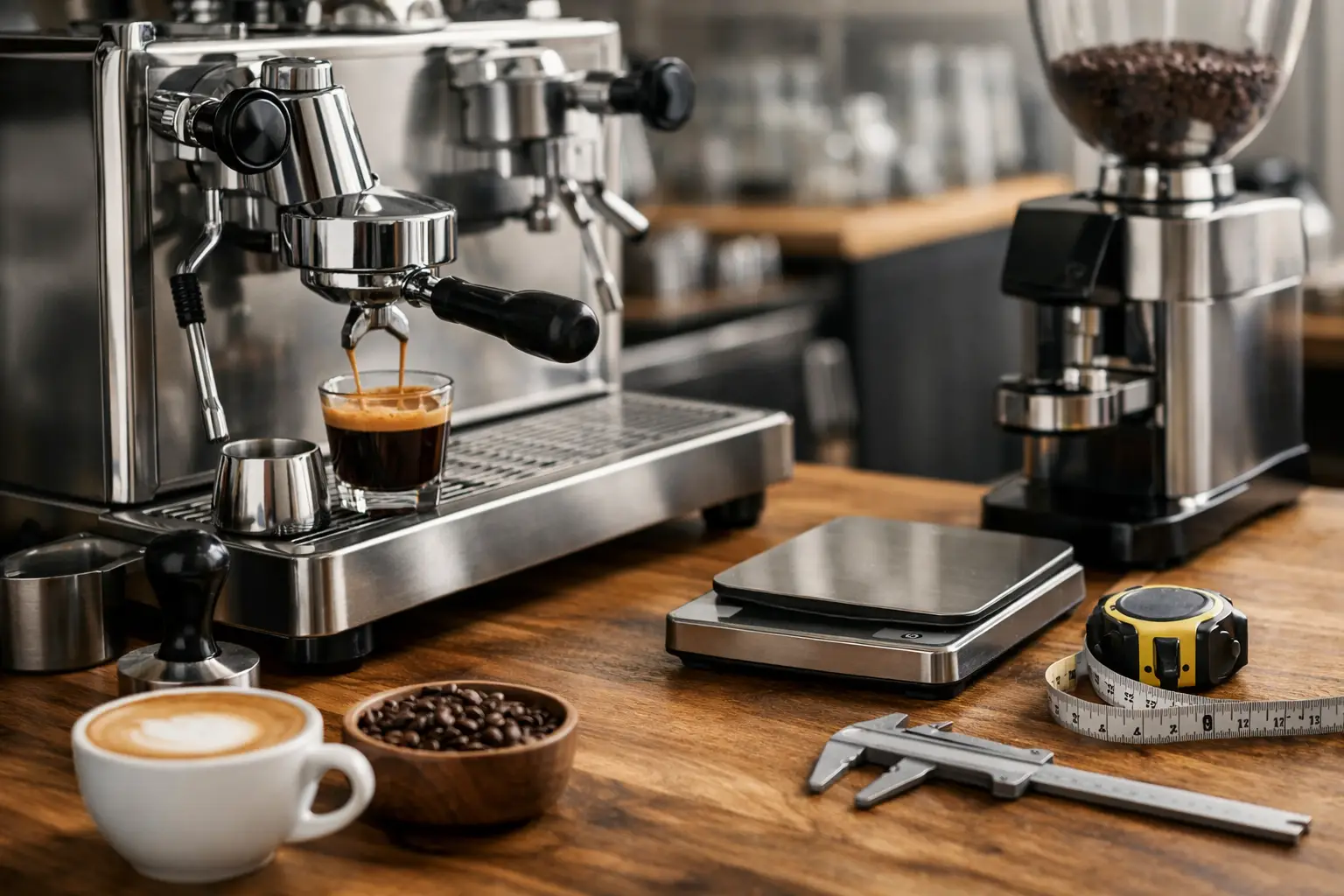
For espresso machines, look beyond the number of group heads. Two groups may work well for moderate trade, while three groups can be the sensible choice where several baristas are producing milk-based coffees through a concentrated morning rush. Boiler recovery, steam capacity, grinder output and bench layout all matter.
One grinder is rarely enough for a busy specialty offer with regular, decaf and alternate beans. Allow room for milk refrigeration, knock tubes, rinser, cups, lids and a clear workflow from order to handover. A fast coffee machine will not fix congestion if baristas are crossing each other to reach milk or takeaway cups.
Refrigeration and cold storage
Size refrigeration by stock volume, delivery frequency and how much food must be held safely during service. A café receiving small deliveries several times a week can operate with less back-of-house storage than one receiving larger deliveries or preparing food ahead for several days.
Do not fill every refrigerator to its listed capacity. Commercial refrigeration needs air circulation, and staff need room to see, rotate and access stock. Separate storage for raw ingredients, ready-to-eat food and beverages may also be needed to support food safety and efficient service.
Underbench fridges can be excellent for line access, but they are not a replacement for a properly sized upright fridge or cool room. Think about what needs to be within arm’s reach during service and what can be stored in the back. For display cabinets, calculate how much product must be presented at the busiest point while maintaining an appealing, well-stocked look.
Calculate cooking capacity by output per hour
When working out how to size café equipment for cooking, ask one direct question: how many portions must this appliance produce in the peak hour? Then allow for cooking times, recovery time and menu overlap.
For example, a fryer may technically hold enough oil for a high volume of chips, but its recovery rate determines whether it can keep up after repeated baskets. A small fryer can suit light snack trade. A café with loaded fries, chicken, calamari and chips on a busy lunch menu may need twin tanks or a larger unit so flavours can be separated and orders keep moving.
The same principle applies to grills, cooktops and ovens. Check usable cooking surface, not just external dimensions. A wider gas cooktop with more burners may be unnecessary if most food is cooked on a grill, while a compact induction unit may be ideal for a limited menu where ventilation or gas access is restricted.
Choose equipment with enough headroom for busy weekends, catered functions or seasonal trade, but avoid buying for an unlikely once-a-year peak. If occasional demand is the issue, a flexible bench-top appliance or temporary prep arrangement can be better value than permanently oversizing the line.
Do not underestimate wash-up capacity
Wash-up is one of the most common café bottlenecks. The dishwasher must clear the volume of cups, glasses, plates and cutlery created during service without leaving staff short of clean items. If staff are hand-washing coffee cups because racks are waiting to be processed, capacity is already too tight.
A glasswasher may suit a coffee-led takeaway venue with minimal plated food. A busy dine-in café often needs an underbench dishwasher, while larger venues or sites with heavy functions trade may need a pass-through machine. Consider cycle time, rack size, water connection, drainage, chemical dosing, ventilation and space for dirty and clean items.
Also calculate the supporting equipment. Dish tables, shelving, sinks and drying areas need to match the machine’s output. There is little benefit in installing a fast dishwasher if clean racks have nowhere hygienic to land.
Make the floor plan work before ordering
Every appliance has an operational footprint larger than its product dimensions. Doors need to open, racks need to slide out, staff need safe access and service technicians need room to work. Refrigeration also requires ventilation clearance, while cooking equipment may need a compliant extraction canopy and fire safety provisions.
Measure doorways, corridors, lifts and delivery access as well as the kitchen itself. A large unit that cannot be brought into the tenancy can create an expensive delay. Check electrical supply, gas capacity, water, waste points and grease management early, particularly in older buildings or shopping-centre sites.
Bench space deserves the same attention as major equipment. A café can have enough cooking capacity on paper but still struggle if there is nowhere to plate meals, prepare sandwiches or pack takeaway orders. Stainless-steel workstations, shelving and mobile benches often deliver more speed per dollar than adding another appliance.
Allow for staffing, budget and growth
The right size is not only about litres, trays or kilowatts. It must suit the people operating the café. A compact, well-organised line can outperform a larger kitchen when staffing is limited and the menu is disciplined. Conversely, a broad menu with multiple cooks needs enough equipment stations to prevent staff from working on top of each other.
Budget decisions should weigh purchase price against operating cost, reliability and downtime. Quality pre-owned equipment can be a practical option for selected items, especially when establishing a venue, while new equipment may make more sense where warranty cover, energy efficiency or precise performance is critical. Finance can also help spread the cost of essential capacity rather than forcing compromises on the items that keep service moving.
A kitchen design and fitout plan brings these choices together. CKE Sydney can help operators match cooking, refrigeration, wash-up and stainless-steel equipment to the menu, site and budget, whether the job is a single replacement or a complete café build.
Before committing, walk through your busiest service from delivery to dishwashing. Follow the milk, eggs, cups, plates and rubbish through the space. The right equipment size is the one that lets staff keep moving, customers keep ordering and your café trade confidently when the rush arrives.