
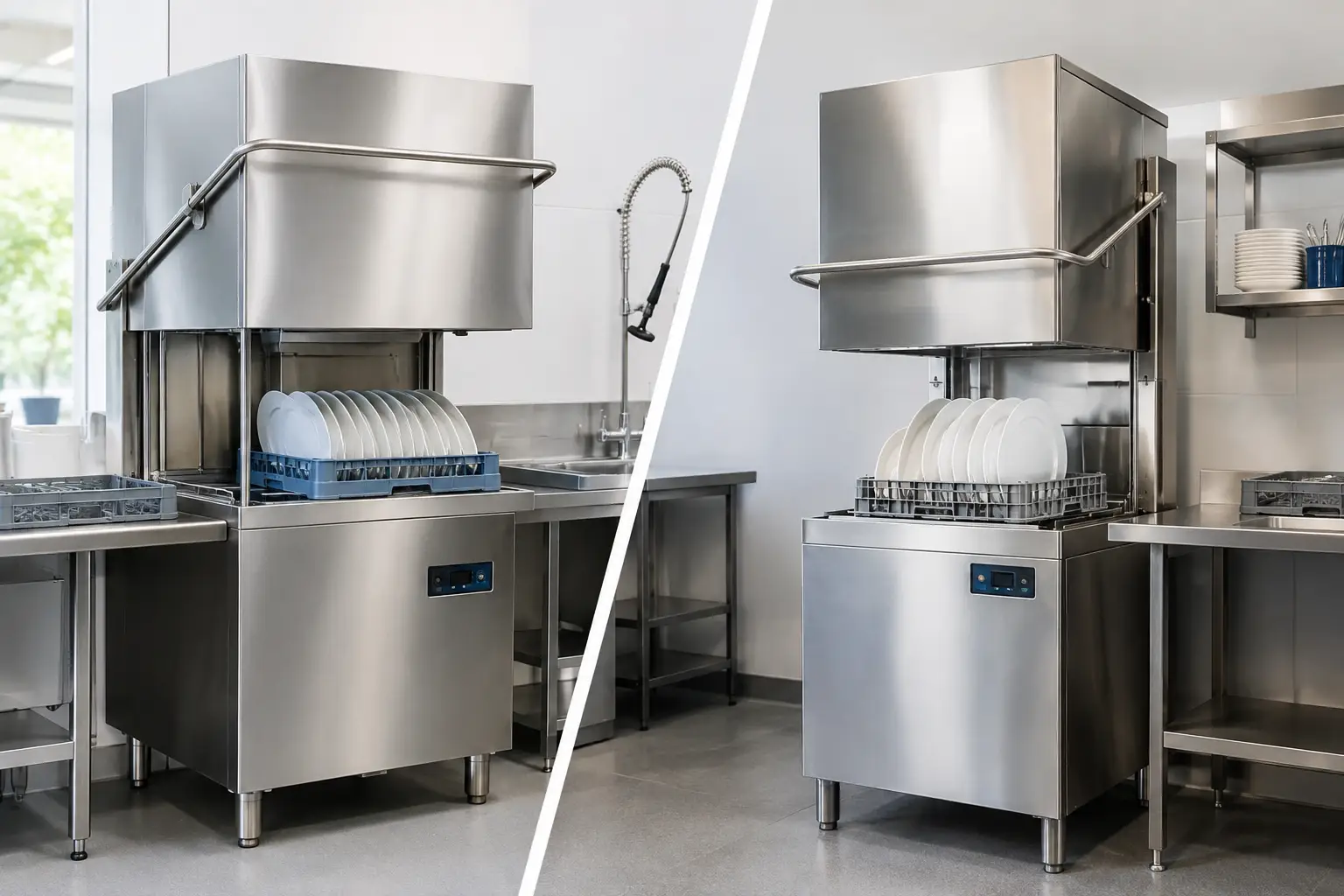
A busy wash-up area can bring service to a halt just as quickly as a failed cool room or fryer. When operators compare a pass through versus bonnet dishwasher, the first thing to clear up is that these terms often describe the same style of commercial machine. A bonnet dishwasher has a lifting bonnet, while “pass through” describes the way it is positioned between dirty and clean dish tables.
That distinction matters. The right machine is not simply the one with the fastest cycle time or lowest ticket price. It needs to suit your peak trade, available bench space, rack flow, staff numbers, power supply and the type of ware coming back from the floor.
Is a pass-through dishwasher different from a bonnet dishwasher?
In most commercial kitchen equipment catalogues, a pass-through dishwasher and a bonnet-type dishwasher are interchangeable terms. Both use a bonnet that lifts up and down over a standard dish rack. Staff load a rack of plates, glasses, bowls or gastronorm pans, close the bonnet, run the cycle and move the rack to the clean side.
The phrase “pass through” usually refers to a linear wash-up layout. Dirty items enter from one side, pass through the dishwasher, then exit onto a clean draining bench or tabling on the other. This keeps soiled and sanitised items moving in one direction, which is easier to manage during a busy lunch or dinner rush.
A bonnet dishwasher may also be installed in a corner or against a wall where space is tight. It is still a bonnet machine, but it may not operate as a true pass-through line. Before comparing models, decide whether you are choosing a machine type or planning a complete wash-up workflow. Often, you are doing both.
When a bonnet dishwasher is the right choice
A bonnet-type machine suits venues that have outgrown an underbench dishwasher but do not need the volume or footprint of a conveyor dishwasher. Restaurants, pubs, clubs, cafés with table service, function venues, school kitchens and aged-care facilities commonly use this format.
Its main advantage is throughput. Rather than bending down to load an underbench unit, staff slide a 500 x 500 mm rack into the machine at bench height. Short cycles help a competent wash-up hand keep plates and glassware circulating through service. The open bonnet also gives staff better access when clearing a jam, checking wash arms or cleaning the tank at close.
For a venue doing a concentrated two-hour rush, this matters more than an all-day capacity figure. A café may have modest dish numbers across the morning, then suddenly need every cup, saucer and brunch plate back in circulation. A suitable bonnet dishwasher helps prevent staff from hand-washing to catch up, which costs time and produces inconsistent results.
There is a trade-off. Bonnet machines need more floor area than an underbench model, especially once you allow for infeed and outfeed benches, racking, chemical containers and room for staff to work safely. They also generally require a more considered installation, with suitable electrical supply, plumbing, drainage and water treatment.
Plan the pass-through layout before ordering
The machine is only one part of the wash-up station. A well-planned pass-through arrangement starts with a dirty landing area where plates can be scraped and sorted. From there, staff rack items, send them through the dishwasher and unload them onto a clean drain bench. Clean ware should not cross back through the dirty side.
This sounds simple until the site is measured. A machine that fits between two benches on paper may leave no room to lift the bonnet, manoeuvre racks or open nearby doors. It may also force staff to carry clean glasses across the path of dirty plates. In a compact Sydney kitchen, centimetres can make the difference between an efficient station and a frustrating daily bottleneck.
Consider where crockery returns from the dining room, where clean items are stored, and who is responsible for the wash-up during peak periods. In a small restaurant, one person may scrape, rack and unload. In a club or high-volume function operation, separate staff may work on each side of the machine. The layout needs to support the way your team actually works, not an idealised floor plan.
For fitouts and major replacements, allow for dish tables, a pre-rinse spray unit, scrap basket or waste point, wall protection and nearby storage for racks. CKE Sydney can assist operators who need equipment advice alongside a wider kitchen design and fitout plan.
Capacity is about peak racks, not seat numbers
Seat count is a useful starting point, but it does not tell the full story. A 60-seat restaurant with fast table turns, plated mains and desserts can generate more wash-up than a larger venue using disposables for takeaway. A function centre may be quiet for most of the week, then need to process a large volume of plates and glassware in a short period.
Ask how many racks you need to process at the busiest point of service, rather than how many plates you wash in a day. Also consider what fills those racks. Dinner plates and cups are straightforward, while deep bowls, large platters, baking trays and pots may need different rack configurations or a separate pot-wash solution.
Cycle times are important, but they should be read in context. A quick cycle does not help if the machine takes too long to recover temperature, the incoming water is too cold, or staff are waiting for racks. Compare the quoted racks-per-hour figure with the actual operating conditions at your premises and leave sensible capacity for busy weekends, events and growth.
Utilities can change the real cost of a dishwasher
Before selecting a model, confirm the site services. Many commercial bonnet dishwashers require three-phase power, although options vary. If your premises only has single-phase power available, upgrading the electrical supply can add cost and delay. Check the machine’s electrical requirements with your electrician before purchase, not after delivery.
Water quality deserves the same attention. Hard water can leave scale inside the machine, reduce heating efficiency and mark glassware. Depending on your local supply and the finish you expect on glasses and cutlery, a softener, filtration system or reverse-osmosis solution may be worthwhile. It is cheaper to plan water treatment at the start than deal with cloudy glassware and preventable service work later.
Drainage, hot-water supply and ventilation also need assessment. A dishwasher releases heat and steam every cycle. Some machines are available with heat recovery or condenser features that reduce steam escaping into the room, but they are not a substitute for reviewing the overall ventilation plan. Your installer and relevant local requirements should guide the final setup.
Compare operating costs, not only the purchase price
A lower-priced dishwasher can be good value if it matches the job and has accessible servicing and parts support. But the cheapest unit is not always the lowest-cost choice over several years. Water use, detergent consumption, electricity demand, chemical dosing, labour time and downtime all affect the true operating cost.
Look for practical features that suit your team: clear controls, easy-to-remove filters, accessible wash arms, a reliable rinse pump where required, and simple daily cleaning procedures. Staff will clean a machine properly when the process is straightforward. If filters are awkward or instructions are unclear, food debris builds up and wash quality soon suffers.
Warranties and service support should be part of the buying decision as well. In hospitality, a dishwasher failure on a Saturday night is more than an inconvenience. It can force staff onto sinks, slow table turnover and create a poor experience for customers. Choose commercial equipment with a support path that makes sense for your location and operating hours.
Choosing between pass-through and other dishwasher types
If your venue has light dish volume, limited space and mostly cups or small plates, an underbench dishwasher may be the better fit. It costs less to purchase and occupies less room, provided staff can keep up with loading and unloading during peak trade.
If your kitchen processes steady high volume, a conveyor or rack conveyor dishwasher may be worth considering. These machines suit larger clubs, hospitals, institutions, event operations and high-output catering kitchens where racks need to move continuously. They require more space, higher capital outlay and a properly designed dish room, so they are not automatically the answer for every busy venue.
The bonnet dishwasher sits in the practical middle. It gives a serious lift in capacity and ergonomics without demanding the footprint of a conveyor line. For many independent restaurants, pubs, caterers and medium-sized facilities, a properly set up pass-through station is the sensible balance of cost, speed and floor space.
Before committing, sketch the complete journey of one dirty plate from dining room to clean storage. If that journey involves backtracking, lifting, crossing paths or waiting for bench space, fix the layout first. The best dishwasher purchase is the one that keeps your team moving when the service is at its busiest.