
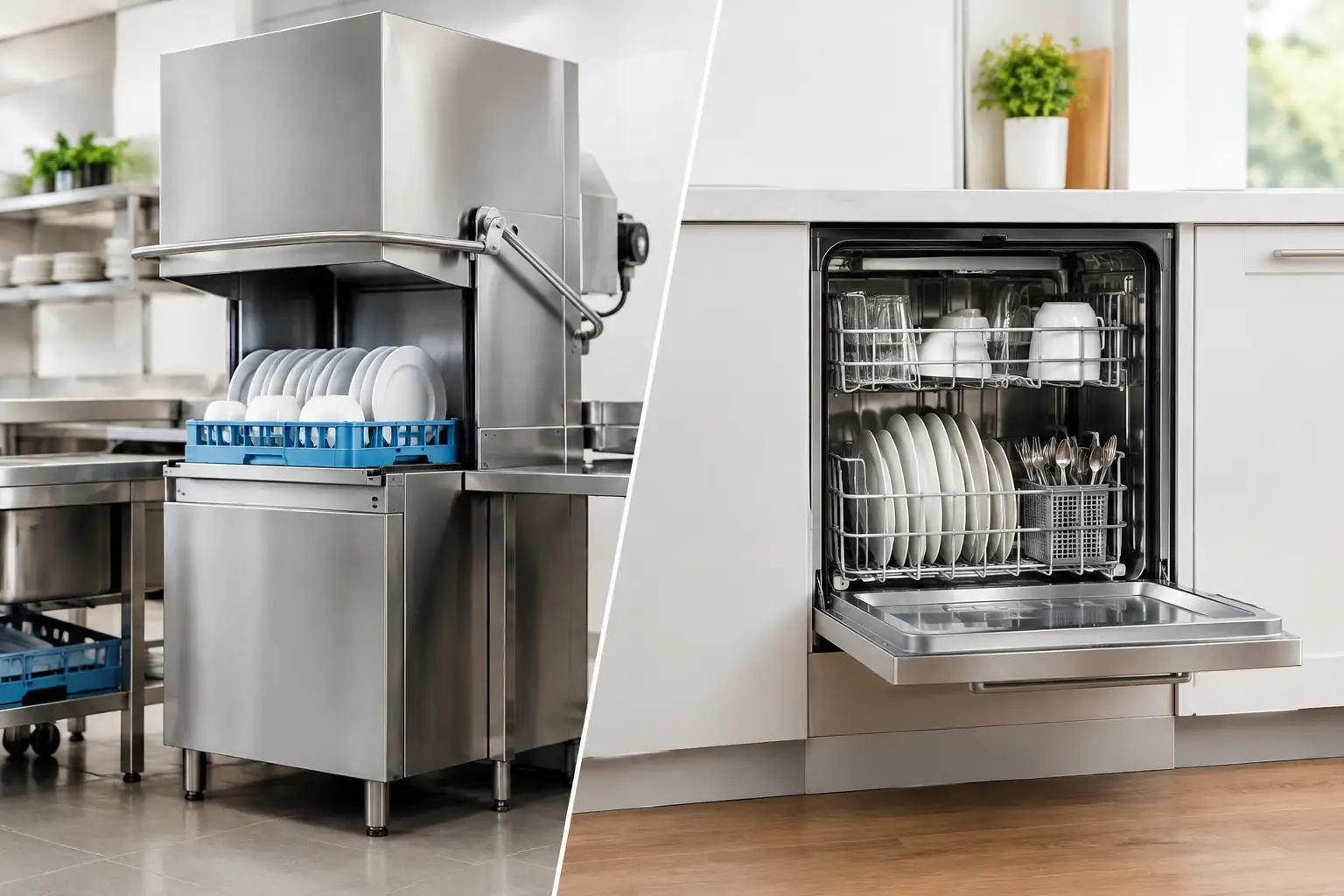
The wrong dishwasher creates a bottleneck at the worst time: plates stacking up after a lunch rush, staff hand-washing glassware, and a kitchen that cannot reset tables quickly enough. Choosing a pass-through versus undercounter dishwasher comes down to more than wash speed. Your available space, service volume, bench layout, staffing and utility capacity all matter.
For a compact café, takeaway shop or small bar, an undercounter machine can be the sensible, cost-effective choice. For busy restaurants, pubs, clubs, caterers and institutional kitchens, a pass-through dishwasher often pays its way in faster turnaround and a more organised wash-up area. The best option is the one that matches your real peak demand, not simply the biggest machine that fits through the door.
Pass-through versus undercounter dishwasher: the main difference
An undercounter dishwasher sits beneath a standard commercial bench, much like a domestic dishwasher but built for frequent commercial use. It is generally front-loading, compact and suited to smaller wash-up areas. Staff load a rack through the front door, run a cycle, unload it and repeat.
A pass-through dishwasher, also called a bonnet-type dishwasher, has a taller frame and a lift-up bonnet. Racks move through the machine at bench height, usually with an entry bench on one side and a clean exit bench on the other. This creates a practical wash-up line: scrape, rinse, wash, air-dry and stack.
Both types use rack-based washing and can produce hygienic results when they are correctly installed, maintained and operated. The major distinction is workflow. An undercounter unit suits lower volumes and tight spaces. A pass-through model is designed to keep racks moving during sustained service periods.
When an undercounter dishwasher makes sense
Undercounter commercial dishwashers are a strong fit where floor space is limited and the wash-up load is steady rather than relentless. Think espresso bars, small cafés, sandwich shops, takeaway venues, small bakeries, office kitchens and boutique restaurants with modest seating.
Their compact footprint is the obvious advantage. They can be installed beneath a bench, leaving room for food preparation, refrigeration or storage elsewhere in the kitchen. They also tend to cost less upfront than a pass-through setup and may have lower installation costs, depending on your electrical and plumbing requirements.
For operators replacing an older unit, an undercounter dishwasher can be a straightforward swap if the existing bench opening, drainage and power supply are suitable. It is also often easier to position in a front-of-house bar area where glassware needs frequent washing but a full wash-up line would take up too much room.
The trade-off is labour and capacity. Each rack needs to be loaded and unloaded at a low level, and staff may need to wait between cycles when volume rises. If one person is also clearing tables, making coffees or running food, dishwashing can quickly interrupt the rest of the shift.
An undercounter machine is not necessarily a low-volume machine. A quality commercial model can handle a busy small venue well. The issue is whether it can keep pace with your busiest 30 to 60 minutes, including plates, cups, cutlery, prep tools and glassware. That is the period worth planning around.
Best uses for an undercounter unit
An undercounter dishwasher is usually the better fit if your venue has limited back-of-house space, mostly serves takeaway, has a smaller dining room, or requires a separate machine close to the bar. It can also suit a second wash point in a larger venue, such as a dedicated glasswasher area, while the main kitchen handles plates and cookware elsewhere.
When a pass-through dishwasher is worth the space
Pass-through dishwashers are built for commercial kitchens where racks arrive continuously. Restaurants with regular table turnover, pubs serving meals, clubs, schools, aged-care facilities, catering kitchens and event venues often benefit from the higher-volume workflow.
The key advantage is ergonomics. Racks travel across benches at waist height, reducing repeated bending and lifting. Staff can pre-rinse and load on one side, then remove clean racks from the other. During a peak period, more than one person can work in the wash-up area without getting in each other’s way.
Cycle times are often short, but the bigger gain is the ability to prepare the next rack while the current one is washing. That keeps the process moving. A well-planned pass-through station can clear a large pile of crockery far more efficiently than an undercounter unit operated by the same team.
Pass-through machines do require more room. Allow for the dishwasher itself, inlet and outlet benches, a pre-rinse spray, drainage, shelving for clean items and enough access for staff to work safely. A bonnet-type machine placed in a cramped corner loses much of its advantage.
Upfront cost is also higher. Beyond the machine price, your budget may need to cover stainless-steel benches, upgraded electrical supply, plumbing changes, ventilation considerations and installation. However, for a venue consistently falling behind on dishes, the labour savings and better table turnaround can justify the investment.
Do not overlook bonnet clearance
Before ordering a pass-through dishwasher, measure above it as well as around it. The bonnet needs enough clearance to open fully, and low shelves, overhead cabinets or ceiling services can create an expensive problem. Steam release should also be considered when deciding where the machine sits, particularly in enclosed kitchen areas.
Compare your actual demand, not just your seat count
Seat count is useful, but it does not tell the full story. A 40-seat café with all-day brunch, large crockery and constant coffee service may create more washing than a 70-seat restaurant with a focused dinner service. Likewise, a catering business may have low daily volume but a major wash-up peak after every event.
Start by looking at your busiest service. Count how many racks of plates, bowls, cups, glassware and cutlery come back in a typical 15-minute period. Add kitchen utensils, gastronorm pans and prep equipment where relevant. Then consider what happens when staff are short-handed or when a large booking arrives at once.
A dishwasher should give you breathing room during those peaks. If the machine only just keeps up on an ideal day, it will become a problem when one staff member calls in sick, a rack is poorly loaded or a cycle needs to be repeated.
Installation can decide the better machine
Dishwasher selection is partly a site-planning decision. Both undercounter and pass-through units need suitable water supply, waste connection, chemical dosing arrangements and electrical capacity. Water quality also matters. In hard-water areas, appropriate filtration or water treatment can help protect the machine and reduce spotting on glassware.
Check the power requirements early. Some units may operate on single-phase power, while others require three-phase supply. Upgrading power after a machine arrives can delay opening dates and add unexpected cost. Your plumber and electrician should confirm the site requirements before you commit.
Drainage is another practical point. Poor drainage can lead to slow emptying, water on the floor and avoidable service issues. Floor levels, waste location and bench layout should all be reviewed as part of the plan.
For new venues and refurbishments, the wash-up area should be designed around the direction dirty items enter and clean items leave. Dirty plates should not cross paths with clean crockery. This supports hygiene, reduces confusion and makes the area easier for new staff to operate.
Cost is more than the purchase price
Price matters, particularly when fitting out a new business, but it should be considered alongside labour, running costs and service impact. A lower-priced undercounter dishwasher may be excellent value for a small operation. In a high-turnover venue, though, the same unit could cost more over time if it requires extra labour or slows table resets.
Pass-through machines generally carry a higher initial cost, yet they can reduce handling time and improve wash-up flow in the right setting. If your team is regularly staying back to finish dishes, or clean plates are running out in the middle of service, the machine is no longer simply an equipment purchase. It is affecting payroll, customer experience and capacity to trade.
Whether you buy new or quality pre-owned equipment, check the warranty terms, availability of service support and access to replacement parts. Ask about water consumption, cycle settings, chemical compatibility and recommended daily cleaning. The cheapest machine is not good value if it does not suit your workload or cannot be supported properly.
A practical way to make the choice
Before selecting a model, work through these five questions with your kitchen team:
- How many racks must be washed during your busiest 15 to 30 minutes?
- Is there enough room for a proper pass-through bench line and bonnet clearance?
- What power, water and drainage services are already available on site?
- Will staff have time to load and unload an undercounter unit during peak service?
- Are plates, glassware and kitchen utensils best handled in one location or separate wash areas?
If your answers point to tight space, lower rack volume and a simple workflow, an undercounter dishwasher is likely the practical choice. If they point to sustained peaks, regular functions, high table turnover or mounting labour pressure, a pass-through dishwasher deserves serious consideration.
CKE Sydney can assist with equipment selection as part of a single replacement purchase or a larger commercial kitchen fitout. Bring your kitchen measurements, utility details and expected service volume to the conversation. A dishwasher should make every service easier, not become the place where it stalls.