
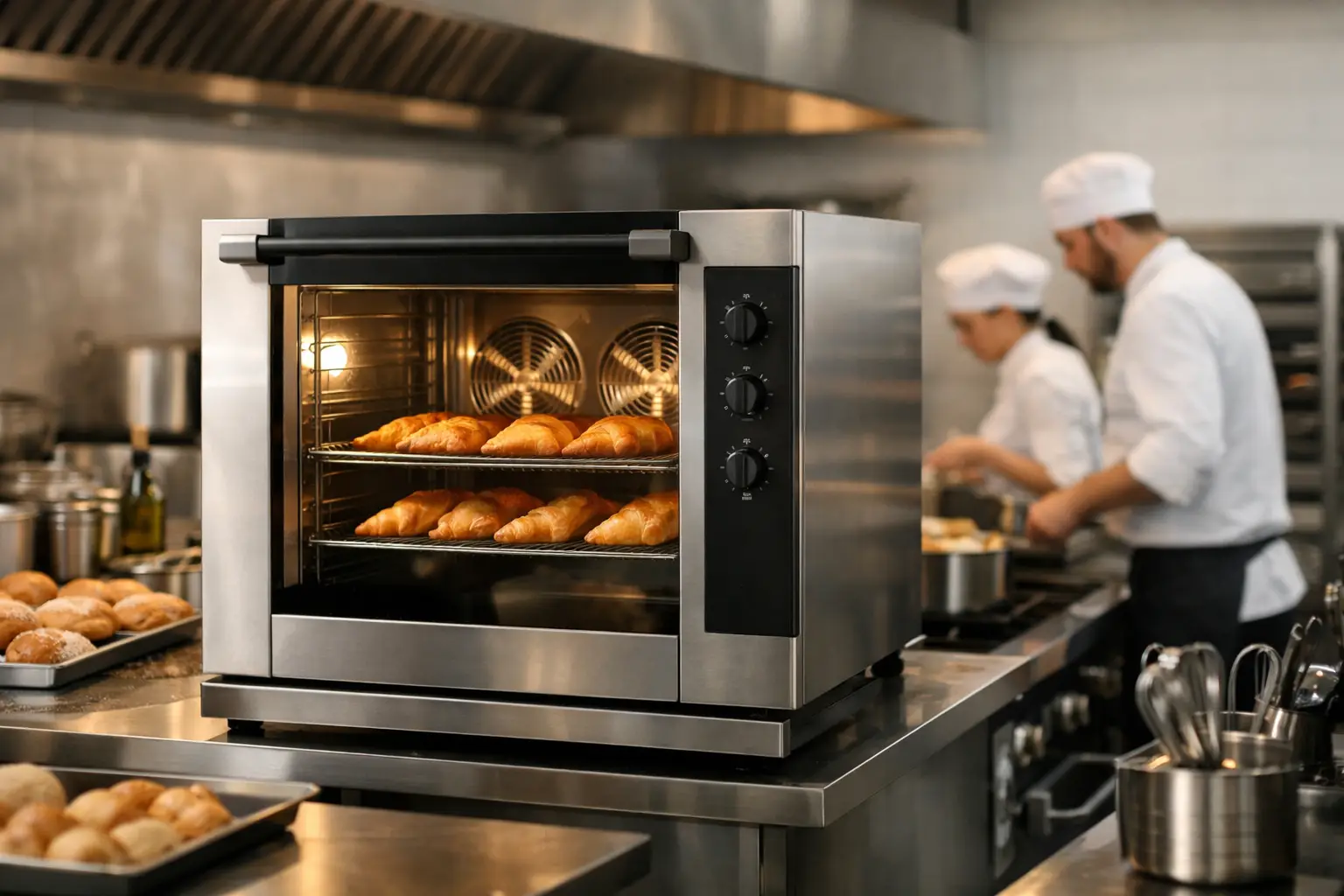
A lunch rush exposes every weak point in a kitchen. If oven trays need rotating by hand, recovery time is slow, or one batch colours differently from the next, staff lose minutes that quickly become late orders. Turbofan convection ovens are a practical answer for cafés, restaurants, bakeries, caterers and institutional kitchens that need dependable baking, roasting and reheating from a compact commercial oven.
Built for regular service rather than occasional home use, these ovens circulate heated air around the cabinet to cook food more evenly and efficiently. They suit operators who need a versatile oven for pastries in the morning, roast vegetables at lunch and plated-function reheating at night – without dedicating a large footprint to a full-size range oven.
What makes a turbofan convection oven useful?
A convection oven uses a fan to move hot air around the cooking chamber. That airflow reduces hot and cold spots, improves browning and helps food cook consistently across multiple trays. The result is less tray swapping, more predictable cooking times and a better chance of producing the same result whether a senior chef or a new team member is operating the oven.
Turbofan ovens are commonly selected for their compact format, straightforward controls and ability to handle varied day-to-day production. Depending on the model, operators can choose manual or digital controls, different tray configurations and bench-top or floor-standing setups. The right choice comes down to what your kitchen actually produces, not simply the largest cabinet that will fit through the door.
For a busy café, a small footprint oven may handle croissants, muffins, toasted sandwiches, pies and bake-off items throughout the day. In a pub or club, it can support the pass with side dishes, garlic bread, desserts and function food. Caterers often value the consistency when producing trays of the same item before dispatch.
Where turbofan convection ovens earn their bench space
The strongest case for a convection oven is usually a menu with repeated oven work. If your team bakes, reheats, roasts or finishes several batches every service, fast and even airflow can remove a bottleneck from the line.
For bakeries and pastry-focused cafés, it helps create repeatable colour and lift across trays. For takeaway shops, it can keep pies, pastries and hot food moving without relying on a microwave finish. For aged care, schools and institutional kitchens, repeatability matters just as much: staff need equipment that can produce reliable results across planned meal periods.
That said, a convection oven is not automatically the best choice for every cooking task. High-moisture baking, slow braising, steaming and more advanced programmed cook-and-hold work may point towards a combi oven instead. A convection oven can be a cost-effective, hardworking addition, but it should match the production method rather than replace equipment with a different purpose.
Capacity is not the same as output
It is easy to focus on the number of trays an oven holds. Tray capacity matters, but output also depends on the food being cooked, loading pattern, recovery time and how often the door is opened. A cabinet packed too tightly restricts airflow and can reduce the consistency you bought the oven for.
Think about your busiest 30 minutes. How many trays need to be ready? Are they all the same product, or do you need room for separate menu items? A smaller oven with a quick cycle and a sensible workflow can outperform a larger unit that creates congestion at the bench.
Also check the tray size and spacing against your current baking sheets, gastronorm pans or food containers. Replacing a full set of trays after installation is an avoidable cost, particularly when fitting out a new venue with several equipment purchases happening at once.
Controls should suit the people using them
Manual dial controls are familiar, quick to train on and well suited to kitchens running a narrow range of products. They can be an excellent option where staff simply need to set temperature and time, then get on with service.
Digital controls can make more sense where multiple team members cook the same products each day or where consistency needs to be documented. Programmed settings help reduce guesswork, but only if the kitchen takes the time to test recipes, record the right settings and train staff to follow them.
Do not pay for complex programming if the oven will only bake a few standard items. Equally, do not choose the most basic controls if a changing team is regularly producing high volumes for functions. The best oven is the one staff can operate correctly during a busy shift.
Key checks before buying turbofan convection ovens
Start with the available bench or floor space, then work backwards from there. Measure the installed position, not just the room. Allow for door clearance, ventilation around the unit, safe access for trays and a clear path for cleaning. An oven that blocks refrigeration access or forces staff to carry hot trays across a tight walkway will create problems every day.
Electrical supply is another early check. Commercial ovens may require different power arrangements depending on the model, so confirm your site supply with a qualified electrician before ordering. This is particularly important in older premises, shopping-centre tenancies and refurbishments where the existing kitchen layout may not reflect current power needs.
Ventilation requirements must be assessed as part of the wider kitchen design. The food being cooked, local regulations, building conditions and the specific equipment all affect the final setup. Do not assume that a compact oven can simply sit anywhere without considering heat, steam, extraction and fire-safety requirements.
Before making a final decision, work through these practical questions:
- What products will the oven cook every day, and what is the largest likely batch?
- Which tray sizes and pans are already in use in the kitchen?
- Is a bench-top model enough, or will a stand improve workflow and storage?
- What electrical supply, ventilation and installation work are required?
- Who will clean, maintain and train staff on the oven after it is installed?
These details are less exciting than selecting a model, but they prevent costly changes once the kitchen is already trading.
Operating costs go beyond the ticket price
A lower purchase price is valuable, but the total cost of ownership also includes energy use, cleaning time, downtime risk and the cost of inconsistent food. An oven that recovers quickly and cooks evenly can reduce rework, waste and staff intervention across hundreds of service periods.
Cleaning should be part of the buying decision, not an afterthought. Crumbs, grease and food residue affect performance and can shorten component life. Make sure the team can safely access the chamber, racks, door seals and fan area as required by the manufacturer’s cleaning instructions. Build oven cleaning into the close-down routine, especially in venues cooking fatty foods or high volumes of pastry.
For operators watching cash flow, finance may make it easier to purchase the right capacity from the start rather than compromising on an oven that will soon need replacement. It is also worth comparing warranty terms, service support and availability of parts. A commercial kitchen cannot wait weeks for a simple issue to be resolved when oven production is central to the menu.
New or pre-owned: choose on condition and workload
New equipment offers current specifications, manufacturer warranty coverage and certainty around history. It is often the clear choice for a new venue, a high-volume operation or a site where compliance and predictable commissioning are critical.
Quality pre-owned equipment can be a smart option for a smaller operation, secondary production area or refurbishment working to a firm budget. The key is condition, not just age. Ask about service history, door seals, fan operation, controls, tray supports and overall cabinet condition. A cheap oven that needs immediate repairs is not a bargain once labour, parts and disruption are included.
CKE Sydney can help operators compare suitable commercial oven options alongside the broader fitout requirements, including benches, refrigeration, wash-up and cooking equipment. This is particularly useful when an oven choice affects the placement of power, extraction, preparation space and the service line.
Make the oven part of the workflow
A turbofan convection oven performs best when the surrounding workflow is planned properly. Put dry storage and tray preparation close enough to reduce unnecessary movement, but keep hot-tray handling clear of customer traffic and cold-storage doors. Use labelled trays, tested cooking settings and realistic loading limits so staff are not improvising during the rush.
The right oven should make service calmer, not add another piece of equipment to manage. Choose the capacity, controls and installation setup that suit your menu now, while leaving enough room for the next stage of your business.